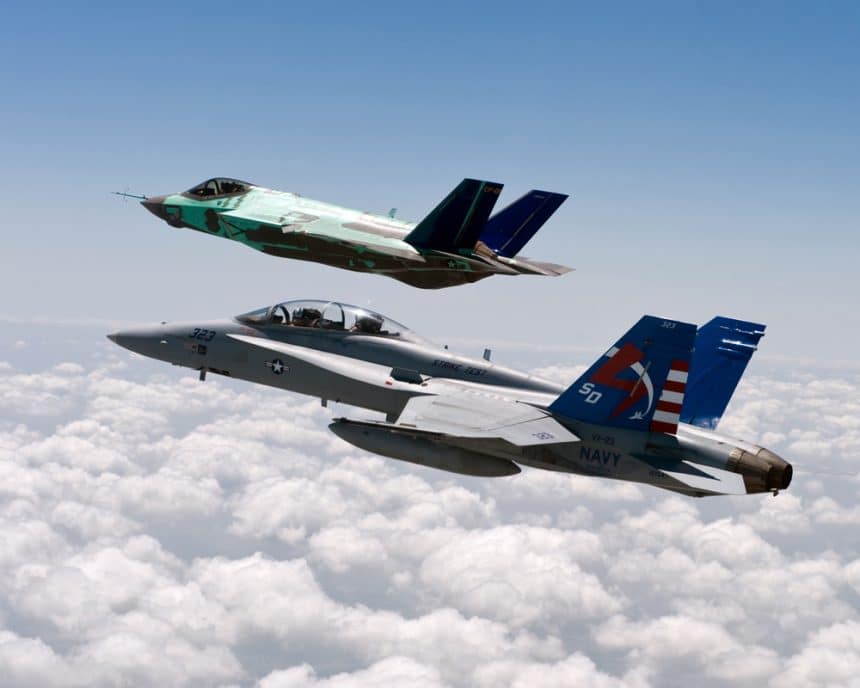
On Jun. 6, 2010, piloted by Lockheed Martin Test Pilot Jeff Knowles’, a retired Naval Aviator and test pilot who flew F-14As and F-14Ds operationally’ and who was also chief test pilot on the F-117 “Nighthawk” stealth fighter program, the F-35C Lightning II carrier variant performed its made its inaugural flight taking off from NAS (Naval Air Station) Fort Worth Joint Reserve Base at 11.46 A.M. LT. The aircraft performed a 57 minute flight that, according to Vice Adm. Thomas J. Kilcline’ Commander of Naval Air Forces marked “the beginning of a new chapter in Naval Aviation” as the new long-range’ stealthy’ carrier-based aircraft “will provide the Carrier Strike Group Commander with an unprecedented ability to counter a broad spectrum of threats and win in operational scenarios that the current legacy aircraft cannot address”.
The F-35C was specifically developed to fulfil the requirements of the US  supercarriers and, as such, it has a larger wing and control surfaces for safe’ precise handling and low approach speeds, and additional structural strength for at-sea operations. Furthermore, the aircraft’ stealth materials are designed to withstand harsh carrier conditions with minimal maintenance. However, even future aircraft carriers will have to adapt to the new aircraft: the F-35C demands more launch energy than a “Rhino” (F/A-18E/F) and for this reason a new Electromagnetic Aircraft Launch System (Emals) was developed and tested for the Ford-class nuclear ships. Emals is a part of a much more powerful electrical generation and distribution system than the predecessor
Nimitz-class ships that employed steam-energized services with 10 km of steam lines. With Emals, the future aircraft carriers will be able to launch the JSF at maximum weight with less wind-over-deck even if, with lower energy levels than those required by a steam catapult, it will be able to lauch also lightly loaded small UAVs (Unmanned Aerial Vehicles). Furthermore, the Ford-cl ass will embody a new landing guidance system: the Joint Precision Approach and Landing System (Jpals). Jpals is also associated with the F-35C, because the new aircraft’s reduced RCS (Radar Cross-Section) means that current radar-based autolanding systems could acquire it.
In the previous months, DoD Buzz obtained some testing documents which raised serious questions about the effects of heat and noise from the F-35B on pilots and ships’ crews, on ship decks and on critical flight equipment.
Docs Say F-35B Too Hot, Noisy
By Colin Clark Wednesday, April 14th, 2010 3:44 pm
Posted in Air, International, Naval, Policy
UPDATED: Lockheed Says Test Data “Out of Date;” Hill Aide Responds
When the Marine Corps commandant says equipment he is buying for his people works and is safe, we listen. So when Gen. James Conway told us the vertical takeoff version of the Joint Strike Fighter was not too hot to damage carriers or amphibious ships and was not too loud to harm crews or communities, we listened. So did some folks on Capitol Hill and they questioned whether the Marine leadership was singing too sweet a song. Testing documents obtained by DoD Buzz, said by congressional sources to be the most recent available, raise serious questions about the effects of heat and noise from the F-35B on pilots and ships’ crews, on ship decks and on critical flight equipment. For example, an operational assessment of the JSF says that heat from the STOVL version may result in “severe F-35 operating restrictions and or costly facility upgrades, repairs or both.” The OT-IID report says “thermal management” will “increase the number of sorties required to prepare an operational unit for deployment during summer months” at most American bases. Overall, it rates basing as red: “unlikely to meet criteria — significant shortfall.”
Another document, a briefing chart rating the plane’s systems, rates as “red” flight operations noise “below deck and island structure” and “on the flight.” Direct exhaust “deck personnel burns” are rated red, as is “personnel blow down” and “off-gassing.” On top of that, the non-skid coating is rated red, as is the impact of the plane’s power systems on “spotting” and the plane’s outwash “on spotting of adjacent aircraft.” A congressional aide was biting in his reaction to Conway’s assurances that the plane was marginally hotter than the AV-8B Harrier and about as loud as existing planes.
“AV-8B and F-35B temperatures might be the same, but so far they haven’t shown anyone their data; plus, you have to look at it from the perspective of total kinetic energy of the engine thrust. AV-8B has a thrust rating of 23,000lbs, whereas an F-35B thrust rating is 41,000lbs. He’s comparing a cigar torch lighter to a blow torch. Additionally, he’s got other thermal issues he needs to worry about as well, like overheating avionics and cockpit temperatures,” the aide said. The testing report says that “continued cycling” of the engine for carrier takeoff raises “serious issues” because a pilot’s backup oxygen supply is depleted when the integrated power package (IPP) is disengaged to give the plane more thrust. Cutting off the IPP also means there is “potential that overheating of the radar and avionics may result.” On top of all that, temperatures inside the cockpit on the ground and in low altitude, high-speed fly “will be high,” more than 90 degrees even during a day when the mercury hits 59 degrees outside. That could “hamper pilot performance” during such missions. The congressional aide then went on to noise. “As for the noise issue, the concern is not in the aircraft flying pattern, the noise concern is for those onboard ship, both above and below deck that are going to have issues. If none of this is a concern, why is the risk matrix still red after developmental testing mitigations are removed?” the aide asked. We showed the documents to Winslow Wheeler, a top defense analyst at Washington’s Center for Defense Information. “The documentation makes extremely clear that the Navy and Marine Corps know they have a problem on their hands. But they don’t know the dimension of the problem and they don’t know how to address it. But the problem is very clear,” he said. Lockheed Martin spokesman John Kent responded to the story this morning, saying, without providing any documentation, that the documents “cited in your story are out of date and incorrect.The information presented in those documents was based on worst-case analysis before extensive testing of the actual F-35B aircraft was conducted during January through March 2010. Results of the aircraft testing show that the difference between F-35B main-engine exhaust temperature and that of AV-8B is very small and is not expected to require any significant CONOPS changes for F-35B.” Kent also said that the “noise data is wrong.” He cited testing conducted by the Air Force Research Laboratory in October 2008. However, that data pertains to the F-35A. That version of the plane was “found to be comparable to that of other high-performance jets — louder than some, quieter than others.” We showed the Lockheed comments to a congressional aide familiar with the data and the reaction was pointed, and skeptical: “Temperature may be the same, but at what force over time is the temperature being applied to the flight deck material and surfaces? The ‘extensive test results’ have not been provided to date. However, if that’s the case, then why was all the modeling and simulation of forecasted heating effects contained in the material incorrect, and why is the risk chart mostly red? Why is the test community very concerned about it in their [annual test] report? Why is the Naval Facilities Engineering Command concerned about it in how they build the VSTOL landing pads? What’s the temperature difference between AV-8B and V-22 engine exhaust, and why does V-22 require special landing mats aboard ship? Why does the Navy plan to not allow the Marine Corps to land F-35B aircraft on aircraft carriers?” As to noise levels, the congressional aide noted that the “test report was dated September 2009; the briefing was dated April 2009. If the test community was convinced by the April briefing, they wouldn’t have included the concern in their September 2009 report. ” Hopefully, we will get more details from Lockheed or the JPO. Those who know can provide data to us without any fingerprints. The congressional staff who spoke said they were concerned that the Marines are unwilling to address what could be fundamental problems for the fifth-generation STOVL plane and, one said, “are purposely disingenuous in their misrepresentation of facts.”
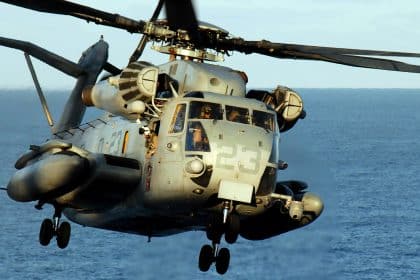
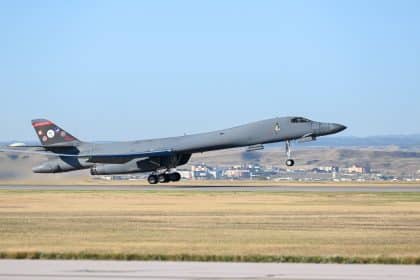
Deck and noise issues are not trivial. After visiting an aircraft carrier during blue-water ops I know that heat, gas, noise on and below the deck are extremely important since they influence the way people work (and, consequently, the way an aircraft carrier fights). It is not a problem of one landing but it is the repetitive type of retr ievals that may get the steel deck hotter for hours since the last aircraft has recovered. Since the deck holds the heat for a long time this may cause the sailors shoe to melt onto the deck causing safety problems and serious injuries. Furthermore, since noice levels are already extremely high below the deck in both private rooms and quarters, undermining sailors possibility to rest, something that would be unproductive at war.