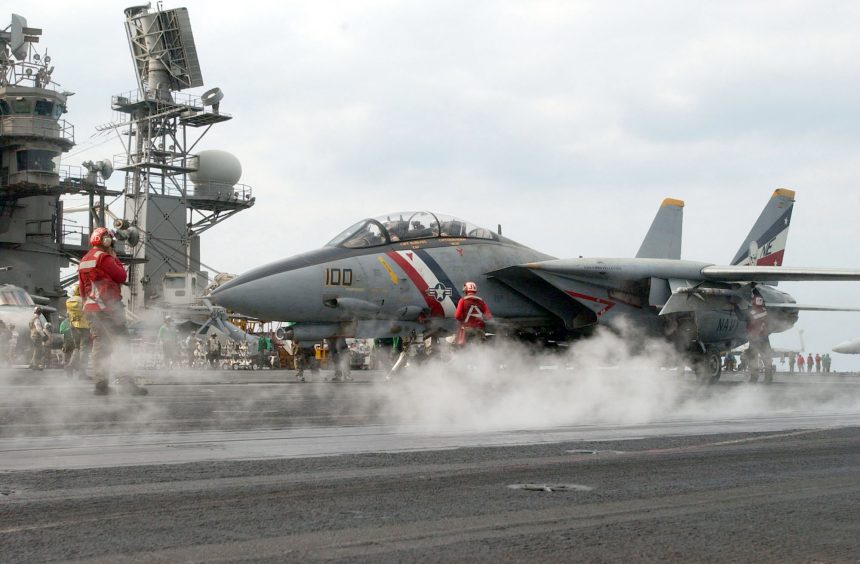
Bounty Hunters F-14s vs Al Mansur.
Operation Iraqi Freedom (OIF) was a huge success for the U.S. Navy’s F-14 squadrons: over Iraq, Tomcat pilots and radar intercept officers (RIO) flew different kinds of missions such as air defense, precision bombing, FAC (A) – forward air control airborne, strike coordination and reconnaissance (SCAR) and photo-reconnaissance.
Among the squadrons that took part in OIF there was the VF-2 “Bounty Hunters” that were embarked on USS Constellation (CV-64). Some of their Tomcats were equipped with the Tactical Airborne Reconnaissance Pod System(TARPS) for recce missions, but when the needs for close air support (CAS) grew, VF-2 TARPS jets were also fitted with 500 lb Mk 82 slick bombs.
The Bounty Hunters Tomcats, armed with these dumb bombs, accomplished a spectacular mission on Mar. 27, 2003, when, as described by Tony Holmes in his book US Navy F-14 Tomcat Units of Operation Iraqi Freedom, two VF-2 crews attacked Saddam Hussein’s yacht.
Saddam Hussein’s presidential yacht was named Al Mansur (The Victor). It was launched in 1982 and amazingly escaped damage during the Iran-Iraq War between 1980 and 1988.
The Al Mansur was decorated with silver and gold fittings and it was Iraqi largest ship, but it had no military use. Before the start of the war the yacht was moved to Basra port for a better protection and it was constantly overseen by Republican Guards troops. The vessel had been attacked only after the Combined Air Operations Center (CAOC) knew that the radio equipments of the ship were used for battlefield communications.
On Mar. 27, 2003 a couple of F-14Ds belonging to the Bounty Hunters of VF-2, were flying near the Euphrates River for a standard TARPS mission. Each jet was also armed with a pair of Mk 82, allowing the two Tomcats to act as gap filler for strike missions.
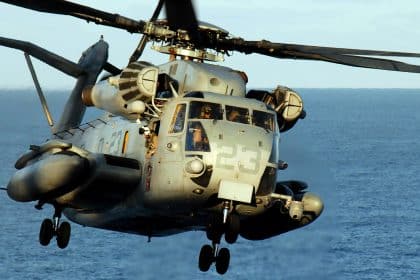
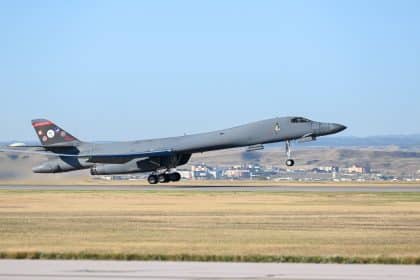
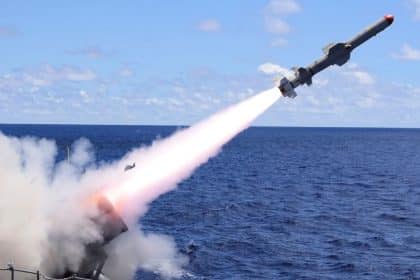
Suddenly, a British Army forward air controller (FAC) asked the Tomcat crews to attack Saddam’s yacht. The ship had already been hit by a Maverick shot by a S-3B Viking but missed by two laser guided bombs (LGB) released by F/A-18 Hornets.
The attack was conducted by the lead Tomcat flown by Lt Mark Callari and Lt Jeff Sims (RIO), while the second F-14, flown by Lt Pat Baker and Lt Sean Mathieson (RIO), provided the cover at high altitude.
The pair of Mk 82 dropped in two bomb runs by Callari and Sims struck the Al Mansur, then the lead F-14 exchanged its place with the other Tomcat. Baker and Mathienson dropped their bombs in a unique run and the two Mk 82 hit the hull above the waterline and the ship’s superstructure.
The two Tomcats headed to the Constellation while the Al Mansur was on fire, but the F-14s crews knew that their bombs did not sink the vessel: since the bombs were armed with istantaneous fuses which they were ideal for the ground support but not for sinking a ship, the Mk 82s exploded before coming into contact with the yacht.
However the damage caused by the Mk 82s was enough to make Al Mansur unusable: it was eventually decommissioned on Jun. 12, 2003, and scrapped at Basra in early 2005.
That deployment was the last one for both the USS Constellation, which was decommissioned on Aug. 6 2003, and for the VF-2 Bounty Hunters with their F-14Ds: in fact on Oct. 6 2003 the unit took delivery of its first F/A-18F Super Hornet and changed its designation from Fighter Squadron (VF) to Strike Fighter Squadron, becoming VFA-2.