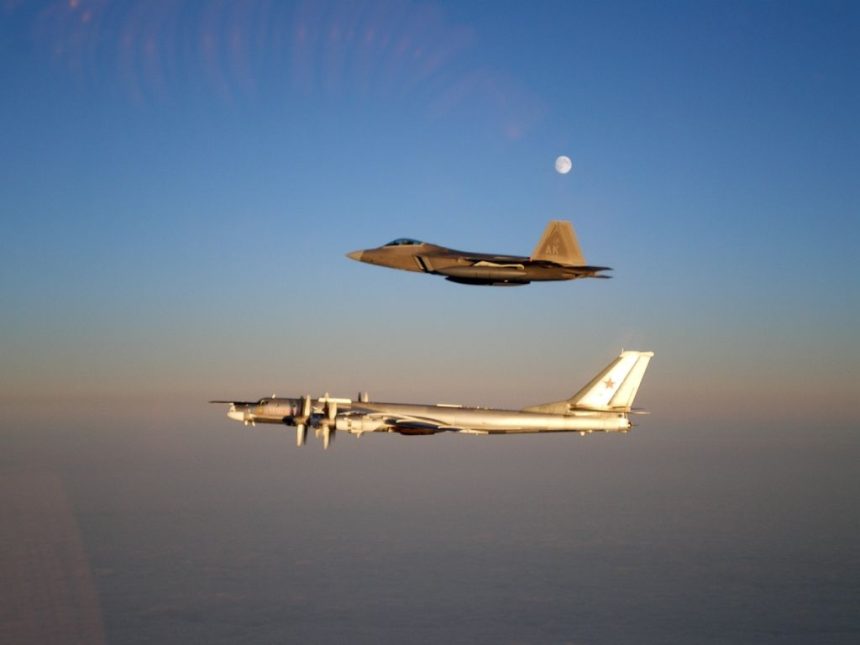
Four Russian Air Force Tu-95 Bear were intercepted by F-22s near Alaska. Two of the strategic bombers came within 50 miles from California Coast.
As we reported few days ago, a U.S. Air Force RC-135U performing a routine surveillance mission in international airspace over the Sea of Okhotsk, north of Japan, some 60 miles off eastern Russia on Apr. 23, was intercepted by a Russian Su-27 Flanker.
Just in case you though only U.S. (spy)planes fly in the vicinity of the Russian airspace, the Washington Free Beacon unveiled that U.S. fighter planes were scrambled to intercept four Tu-95 Bear H bombers, two of those came within 50 miles of California coast.
Two USAF F-22 Raptor stealth jets, most probably from 3rd Wing at Joint Base Elmendorf-Richardson intercepted the “intruders”, that were seemingly conducting a training attack run, over the Aleutians.
Then, two of the four Tu-95s headed back home, whereas the remaining two flew off Northern California, triggering another alert scramble by NORAD (North America Aerospace Defense Command) that dispatched two F-15s to intercept and shadow the Russians.
According to the defense officials who talked to the Free Beacon, the bombers were supported on their (typical) long range mission by two IL-78 tankers .
Even if such close encounters are quite normal across the world, we can’t but notice that they have become at least more frequent in the last couple of years.
For sure Russia’s annexation of Crimea and growing tension between Washington and Moscow have given headlines like “Tu-95s flying close to Guam“, “Su-27s performing reckless interception of U.S. spyplanes“, “B-52s and B-2s temporarily deployed to the UK” and so on, a completely new meaning.
Top: File Photo of F-22 intercepting Tu-95 (U.S. Air Force)