An incredible air-to-air engagement, where one U.S. pilot alone survived to six North Vietnamese MiGs.
A true milestone in the progress of naval aviation, the Vought F-8 has been one of the few carrier-based fighters that could outperform most land-based counterparts.
Being the first genuinely supersonic naval aircraft, the Crusader, was a single seat, single engine swept fighter that introduced an unusual feature, the variable incidence wing. Armed with four Colt Mk 12 cannons, the F-8 was called “The last gunfighter”: these guns combined with its high thrust-to-weight ratio and with its good maneuverability, made of the Crusader a good dogfighter.
The Crusader showed its ability in close combat during the Vietnam war, especially on Dec. 14, 1967: in fact, as explained by Barrett Tilman and Henk van der Lugt in their book “VF-11/111 Sundowners”, on that day, Lt. Cdr. Richard “Brown Bear” Schaffert (the VF-111 Sundowners operation officer during the 1967 deployment onboard the CV-34 USS Oriskany), were involved in an aerial combat which became a classic dogfight of the jet age, even if did not result in any MiG kill.
Schaffert was escorting an A-4E Skyhawk, piloted by Lt Charles Nelson, tasked in an Iron Hand anti-SAM (Surface to Air Missile) mission in the area between Hanoi and Haiphong, when “Brown Bear” saw two MiG-17s (“Fresco” based on NATO designation).
Schaffert immediately started a descent from 18,000 ft and when he recovered at 3,000 ft, he looked for Nelson but he found two more MiGs. Having lost the sight of the A-4E, Brown Bear understood that he had to rely on his 3500 hours of flight experience to face four bandits alone. He started the dogfight with an 8 Gs break forcing the first Fresco to overshoot, but Schaffert knew very well that he had to fight working in the vertical, since the F-8 couldn’t turn as fast as a MiG-17.
As it became obvious that the four bandits had split into two sections,Schaffert started a series of yo-yo maneuvers using the afterburner, trying to reach an advantage position against the MiGs, leaving the chance to Brown Bear to conduct the dogfight as a 1 vs 2 engagement.
Schaffert got a “good tone” from one of its Sidewinders, but the second pair of MiG-17s shot at him with their cannons and he had to perform three more yo-yos before launching a Sidewinder….which didn’t explode. Now he had only two missiles left since one of the four AIM-9s carried by the F-8 had already experienced a failure before take off.
Executing reversal maneuvers and pulling high Gs to defeat the superior turning radius of the MiG-17, Schaffert shot another missile which failed to explode.
Then, two MiGs fired a couple of IR-guided K-13 missiles (AA-2 Atoll as reported by NATO designation) which failed to get on target because they were launched out of the missile operative envelope. Brown Bear found himself once again in a good firing position but this time the guidance system of the last Sidewinder failed, leaving Schaffert with only the rounds of his plane’s four Colt cannons.
After another 5 Gs turn, he had a good tracking solution on a MiG but when he pulled the trigger, all the four 20 mm cannons…choked!
The problem was caused by a common defect of Crusader cannons: the pneumatic ammunition feed system disconnected after high-Gs maneuvers.
Two MiG-21s joined the air combat firing two more Atolls missiles, which Brown Bear was able to avoid.
Facing six adversaries, Schaffert started another series of high altitude yo-yos and engaged the enemy leader in a vertical rolling scissors; once he had reached the bottom of the maneuver, he accelerated towards the coast leaving the enemy behind. He returned safely to the USS Oriskany with almost no fuel left.
Despite the fact that Brown Bear didn’t shoot down any enemy fighter, he left an important lesson to Topgun instructors: how to survive in a dogfight alone against six MiGs, a good lecture to give to the Fighter Weapons School students in the following years.
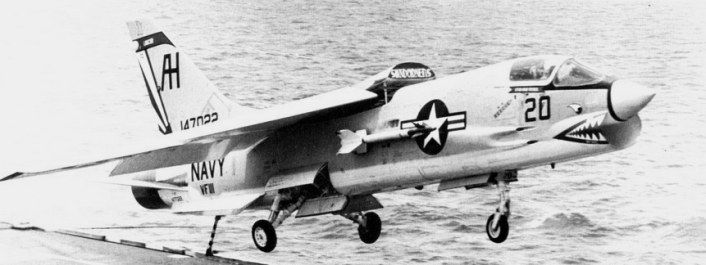
Image credit: U.S. Navy