New Carrier Continues Expansion of Chinese Expeditionary Capability.
China launched its first domestically produced aircraft carrier earlier for sea trials this week at the northeastern port of Dalian, in the south of Liaoning Province, China. The new ship has not been named yet and carries the temporary designation “Type 001A”.
The new Type 001A is a slightly larger vessel than China’s previous aircraft carrier, the Liaoning, that was purchased from Ukraine in 1999 and originally built in 1985 in the then-Soviet Union as a Kuznetsov-class aircraft cruiser. Liaoning has had three names: first christened as the Riga under Soviet use, then renamed the Varyag and finally the Liaoning after the Chinese purchase in 1999. Analysts report the primary role of the Liaoning has been a training vessel for the development of Chinese carrier doctrine and operations.
The new Type 001A is 315 meters long and 75 meters wide as compared to the slightly smaller Liaoning that is 304 meters long and 70 meters wide. Both ships displace roughly 50,000 tons, significantly less than the Nimitz-class carriers with a loaded displacement of between 100,000–104,000 tons. The U.S. Nimitz-class carriers are also longer at 333 meters.
Like the older Soviet-era carriers and the existing Russian Kuznetsov carrier along with the United Kingdom’s new Queen Elizabeth class aircraft carriers, the new Chinese Type 001A uses a ski-jump style launch ramp. India is also building a new ski-jump aircraft carrier, the Vikrant class carrier, formerly known as the “Project 71 Air Defense Ship” (ADS) or Indigenous Aircraft Carrier (IAC) program.


Unlike the other carriers however, the UK’s Queen Elizabeth class uses two superstructures and may have a provision for the removal of the ski-jump launch structure in favor of an electromagnetic catapult in the future.
The Electromagnetic Aircraft Launch System (EMALS) is an emerging technology in new aircraft carriers. The U.S. has already demonstrated and installed the EMALS launch capability on the new Gerald R. Ford class of aircraft carrier in service since 2017. China is considering the use of electromagnetic launch systems on their planned next generation aircraft carrier, the Type 002. China has reportedly already experimented with aircraft modified to be launched with an electromagnetic catapult in anticipation of the next-gen Type 002 development.
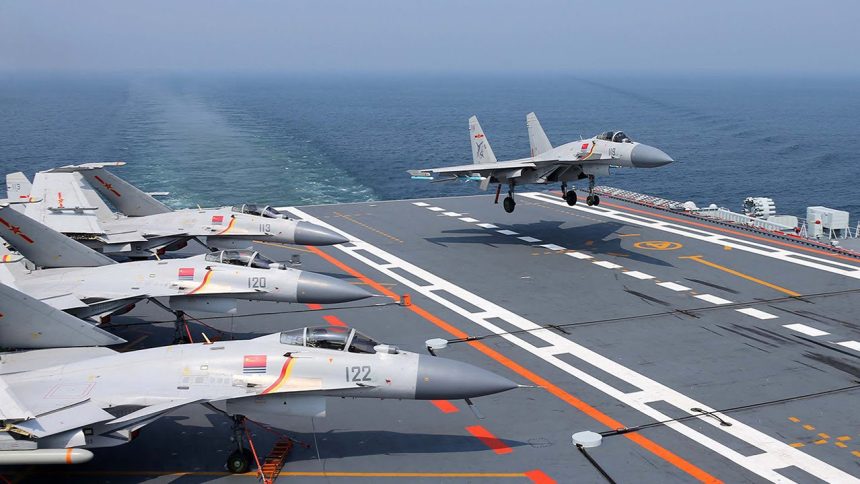
One reason China may be pursuing the EMALS launch system for future carriers could be an inherent limitation to their current launch system. According to intelligence outlet Southfront.org the Chinese are currently limited in launch weight with their existing Short Take-Off But Arrested Recovery (STOBAR) system. That means China’s J-15 tactical aircraft already tested on the carrier Liaoning are limited in take-off weight. The aircraft must sacrifice fuel and/or weapons load to get airborne from the short take-off ski jump ramp. China will develop a new combat aircraft to fly from the decks of their planned Catapult Assisted Take-Off But Arrested Recovery (CATOBAR) aircraft carrier.

Earlier this week an unnamed source told the Navy Times that the first trial of China’s new Type 001A, “May just involve turning a circle in Bohai Bay, making sure every deck under the water does not suffer leaks. Safety is still the top priority of the maiden trial. If no leaks are found, the carrier may sail farther to make it a longer voyage, probably two or three days.”
While China’s progress in aircraft carrier technology has been moving forward rapidly the testing protocols for the new Type 001A suggest a cautious approach to the program. One certainty is that China’s massive investment its aircraft carrier program confirms their ambitions to project security for its national interests and the interests of its allies well beyond its coastline.
Top image: China’s current flight operations onboard their carriers are limited in take-off weight by their deck design. (Photo: via Southfront.org)