Clip Shows “Third Day of War” Loadout Air-to-Ground Precision Weapons Test.
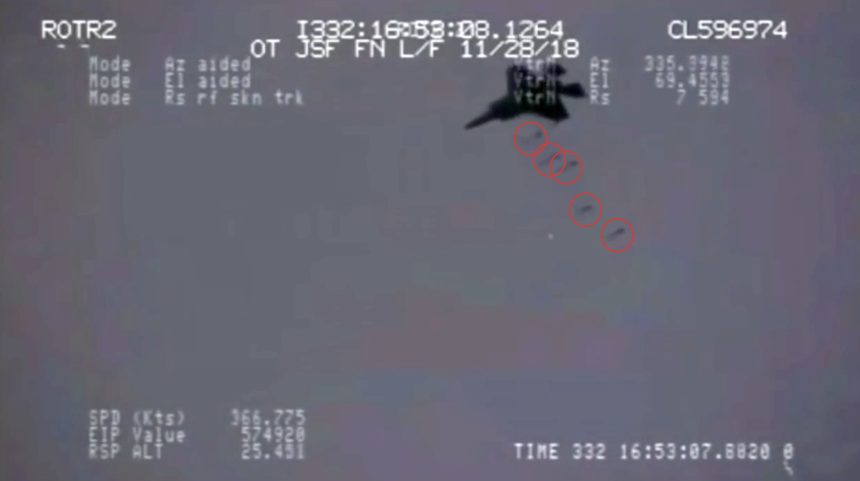
A video has surfaced on several social media outlets including Reddit and Instagram showing a Lockheed Martin F-35 Joint Strike Fighter releasing five air-to-ground weapons simultaneously with subsequent scenes where the weapons hit several targets precisely. The video sources go on to claim that at least one of the targets was “moving at almost 40 mph”.
The telemetry displayed in the video dates it on November 28, 2018 (even though the close up on the moving target is dated Dec. 3, 2018), but the video surfaced on the internet late last week (it was released by the RAF 17Sqn on Instagram). Defense expert and author Ian D’Costa told TheAviationist.com, “It’s an F-35 at NTTR (Nellis Test and Training Range), I could be wrong, but it [seems to be] dropping five Paveway IVs and hitting all five targets with GEOT (Good Effect on Target).”
Ian D’Costa’s analysis is likely accurate even though the location is probably the controlled range at Naval Air Weapons Station China Lake, California and different types of bombs might have been used.
There have been test drops of the Paveway IV precision guided bomb from both test F-35 aircraft and from U.S. Marine F-35Bs. However, only the British and the Saudi Arabians are currently reported to be using the Paveway IV 500-pound smart bomb operationally.
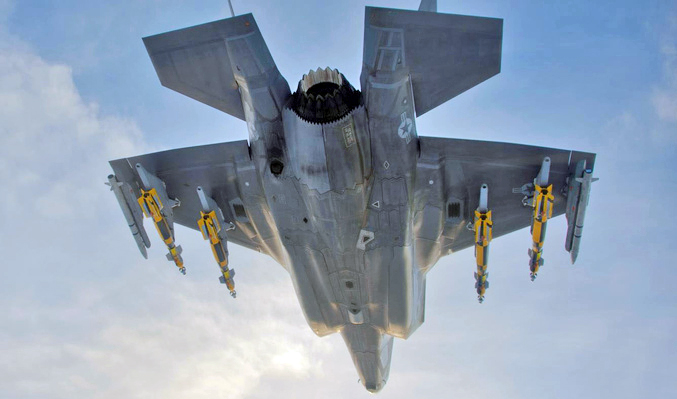
In the weapons carrying configuration shown in the new range video the F-35 is carrying the Paveway IVs in a “third day of war” configuration sometimes referred to as “beast mode” on the outside of the aircraft. The F-35 is equipped with an internal weapons bay capable of carrying munitions including air-to-air missiles and, in U.S. service, two 2,000-pound GBU-31 JDAMs (Joint Direct Attack Munitions) with Mk-84 warheads.

When the F-35 carries all of its weapons internally it maintains its low observability or “stealth” capability. This is a critical asset during the earliest phase of a conflict when combat aircraft are operating in a non-permissive environment with threats like surface-to-air missiles, automatic radar guided anti-aircraft guns and enemy aircraft. The F-35s low observability and internal weapons bay enable it to operate with greater autonomy in this high-threat environment. Once the surface-to-air and air-to-air threat is moderated the F-35 can begin to prosecute targets using externally carried precision strike munitions that will increase the aircraft’s radar signature but are employed at a time when enemy air defenses have been suppressed and are less of a threat to aircrews.
This video is significant since it continues the trend of showcasing the F-35’s emerging capabilities, at least in a testing role. Critics of the F-35 program have often claimed the aircraft is limited in its ability to effectively operate in a hostile environment. In 2018 however, both the Israeli Air Force and the U.S. Marines employed the F-35 in different variants in combat. In the case of the Israelis, there was a persistent surface-to-air and air-to-air threat in the region where the combat operations were conducted.

Earlier in 2018 an F-35 made headlines when it intercepted two drones, or remotely piloted aircraft (RPA’s) simultaneously during a successful test using AIM-120 AMRAAM (Advanced, Medium Range, Air-to-Air Missiles). The two drones were simultaneously detected and killed using the F-35’s Electro Optical Targeting System or “EOTS”.
USAF Lt. Col. Tucker Hamilton, Director of the F-35 Integrated Test Force and Commander of the 461st Flight Test Squadron at Edwards Air Force Base, California, told reporters last year, “Two AMRAAMs had multiple targets – to shoot two airborne targets simultaneously. It was a complex set up that happened over the Pacific. They were shooting at drones.”
While potentially valid criticisms of the F-35 program continue, many focused on cost and maintainability of the complex weapons system, the program has scored a consistent year-long run of developmental and operational victories with only one significant setback when a U.S. Marine F-35B crashed in late September last year. The pilot escaped that accident.
In the social media space the buzz about the F-35 took a turn last week when smartphone video of the USAF’s new F-35A Demo Team practicing at Luke AFB surfaced. Online observers expressed surprise and excitement over the maneuvers displayed in the video with one comments on social media remarking, “With this (new video) and the maneuvering GIF I’m beginning to think the F-35 might be more capable than the naysayers have been complaining about.”