U-2 Wreckage Is Haunting Insight Into The Cold War, Shows How Far We’ve Come.
I grew up during the Cold War. We viewed the Soviet Union as our defacto enemy, an “evil empire” rooted in gulags and surveilled by secret police. As an American, I believed the Soviet Union started the domino effect of Communism, helping to topple at-risk governments around the world: East Germany, Czechoslovakia, Cuba, North Korea, North Vietnam and into Africa. When I was a kid, we had a convenient bad guy: The Soviet Union. The “Red Menace”.
I grew up on Alistair MacLean’s “Ice Station Zebra”, Tom Clancy’s “Hunt for Red October”, all of the James Bond movies. By the time I visited the Berlin Wall as a member of an Army National Guard surveillance and intelligence gathering unit, I had learned about Soviet doctrine, history, equipment and more. We were the “good guys”. As I peered through binoculars over neatly plowed minefields and rolls of razor wire, East German border guards were peering back. They were the “bad guys”. It all seemed very simple.
That was our reality back then. Until December 26, 1991, when the Soviet Union collapsed.
Today our relationship with Russia has progressed more significantly than any level of détente since the end of WWII. And so has the new Russia, the Russian Federation, the country that rose from the collapse of the Soviet Union. Last summer I got to enjoy the benefits of this hard-won (by both sides) détente. I finally got a chance to visit Russia as a journalist. One of the things I wanted to see was the wreckage of Francis Gary Powers’ U-2 spy plane.
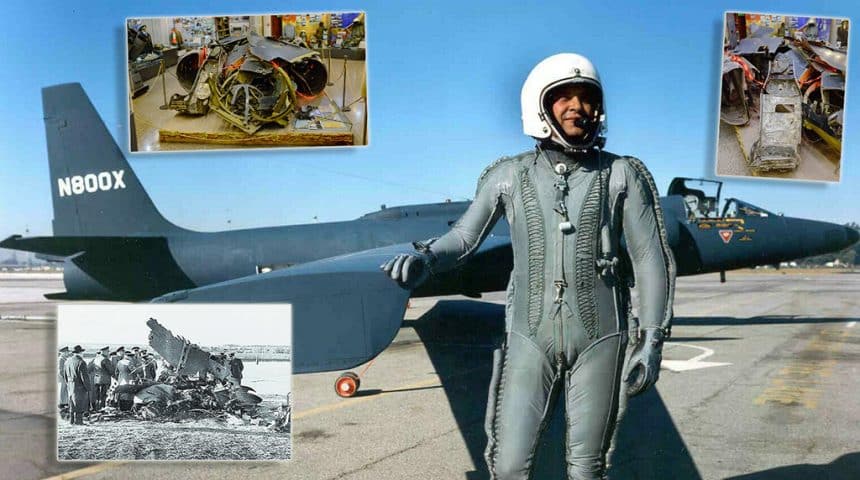
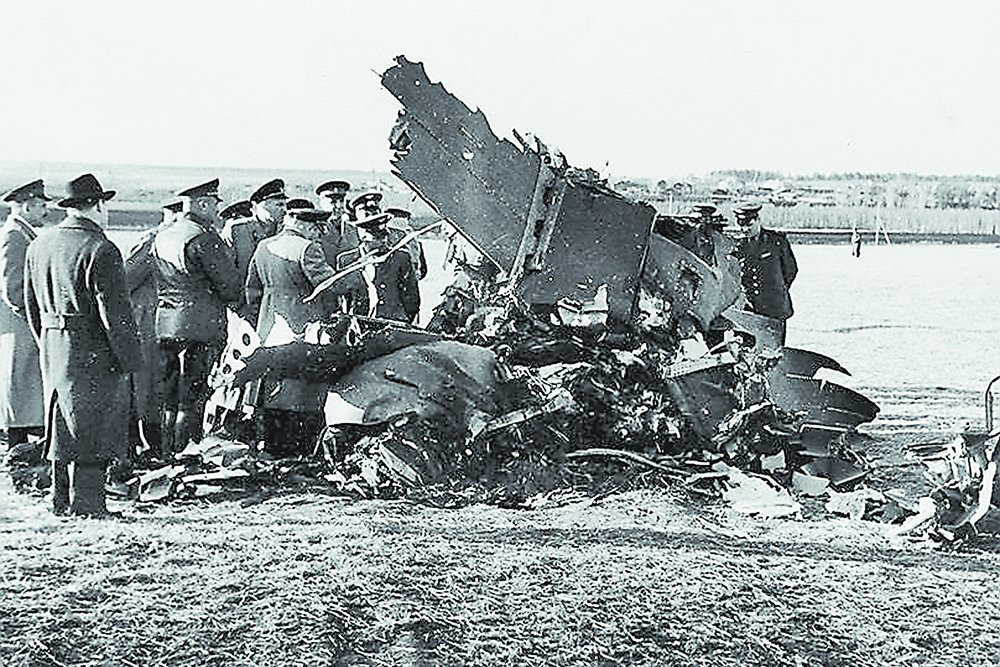
Francis Gary Powers was shot down over the Soviet Union 60 years ago today on May 1, 1960. His U-2 spy plane was hit by an SA-2 Guideline surface-to-air missile, one of 14 fired at him as he flew at approximately 70,500 ft. over Sverdlovsk. His aircraft broke into pieces, spiraling downward in an inverted, nose-down attitude. Centrifugal force prevented him from using his ejection seat and actuating the U-2’s self-destruct mechanism. When Powers jettisoned the canopy of the U-2, he was thrown clear of the wreckage as it disintegrated around him. After parachuting to the ground, he was immediately captured.
The drama that followed included a feeble cover-up attempt by Washington. That compelled the Soviet Union to reveal that they had captured Francis Gary Powers and recovered the wreckage of his U-2. Then-President Dwight D. Eisenhower finally accepted responsibility for the spy flights over Soviet territory. Powers was subjected to a trial and confessed to espionage, sentenced to 10 years in prison by the Soviets. He was later traded for captured-KGB agent Rudolf Abel on February 10, 1962, exactly 650 days after he had been shot down.
Sergei Khrushchev, the son of former Soviet Premier Nikita Khrushchev, wrote in the foreword of the 2019 book “Spy Pilot”, written by Francis Gary Powers’ son, that, “In 1957, Colonel Rudolf Abel was captured by American authorities in New York City and rightly convicted of espionage and sentenced to a long prison term. In 1960, after being shot down while flying a U-2 spy plane over the Soviet Union, Francis Gary Powers was rightly convicted of espionage and sentenced to a long prison term. Both men were patriots who loved their country, believed fervently in their nation’s ideals, and worked for the cause of world peace, before running out of luck.”

Standing in Moscow’s Central Armed Forces Museum you begin to understand Russia’s historical mindset. Russia covers 11 times zones and borders 14 countries. They have military bases in 9 countries outside Russia. By contrast, the United states covers 5 time zones, borders 2 countries and has military bases in 70 countries. In WWII, a reasonable estimate of Soviet losses totaled 20 million people, 8.6 million of those were military. The United States lost 407,000.
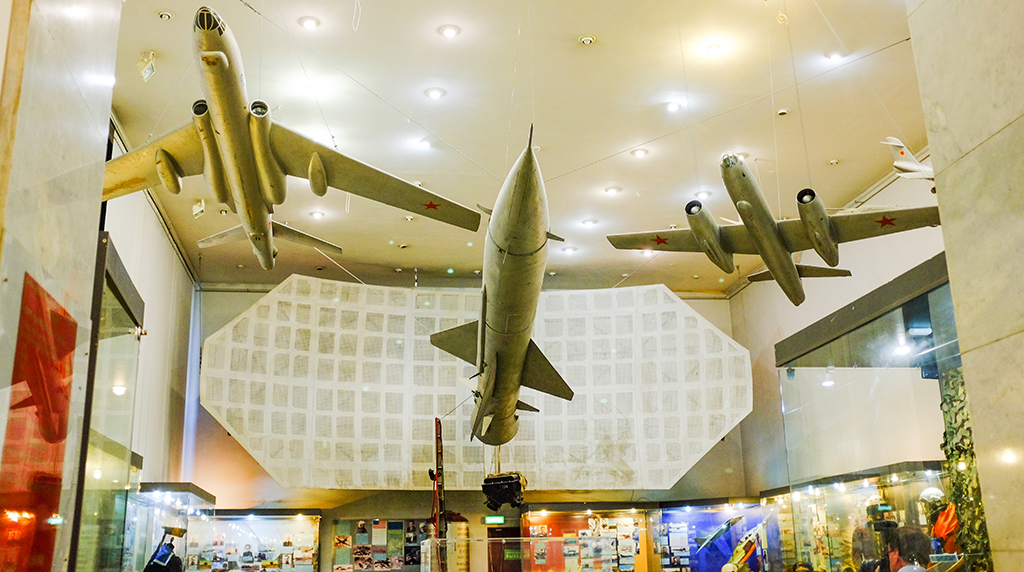
It is not revisionist history to view Russia as a country that has been continuously threatened, ruthlessly exploited, but never conquered. It only takes a few hours of touring modern Moscow to understand the most conspicuous quality of Russia and Russians: strength.
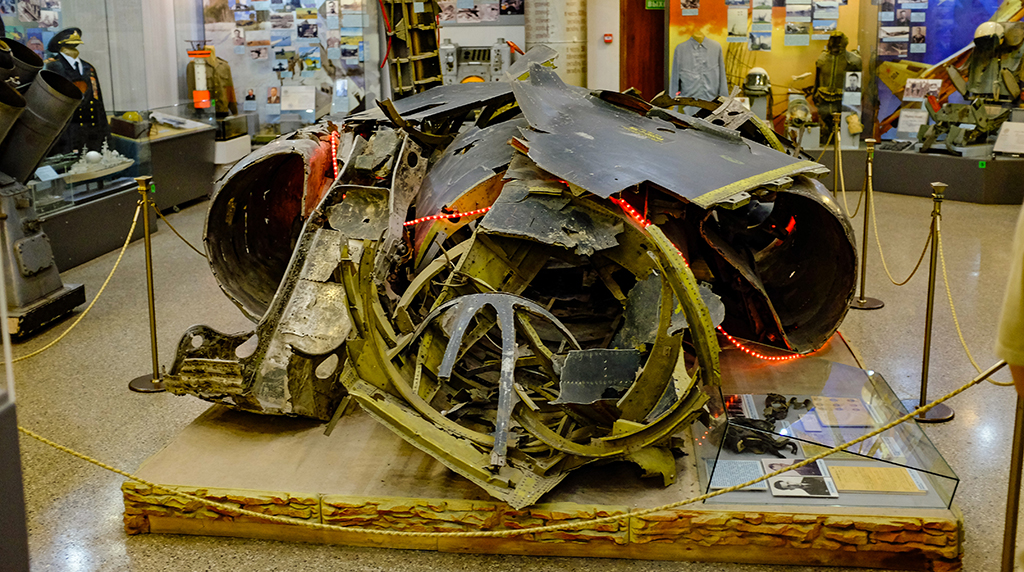
I expected something sinister from the exhibit of Gary Powers’ wrecked U-2. I thought there would be an attempt to seize some propaganda value from the artifact. Instead, the wreckage of Powers’ U-2 spy plane sits rather inconspicuously in the center of a room crowded with Cold War artifacts. Oddly, a string of inexpensive, blinking red LED lights is draped over the wreckage, I don’t know why. In the corner, an older woman sits quietly, presiding over all of the displays in the room. When we began to shoot a video report about Powers’ aircraft, she politely asked us to stop. There were signs in Russian that said still photography was permitted, but no videos. Thankfully, our friend Alex, a Moscow native, smoothed things over for us, but not before our cameraman Lance Riegle and myself had inadvertently reinforced ugly American stereotypes.

Seeing the wreckage of Powers’ U-2 and understanding its context in Russian history helps heal the rift of lingering Cold War dogma. When I got back to the United States and talked about our trip I was surprised to learn how many Americans still viewed Russia as a de facto adversary. But for me, seeing Russia’s exhibit of Powers’ aircraft and the rest of the Cold War artifacts did not change my view of Cold War history, it added depth and perspective to it. It granted an insight into what it may have felt like to live in a country threatened at nearly every border, nearly wiped out in an invasion only two decades earlier. Learning to see the Cold War from the Russian perspective in addition to the American perspective is not revisionist history. It’s complete history.