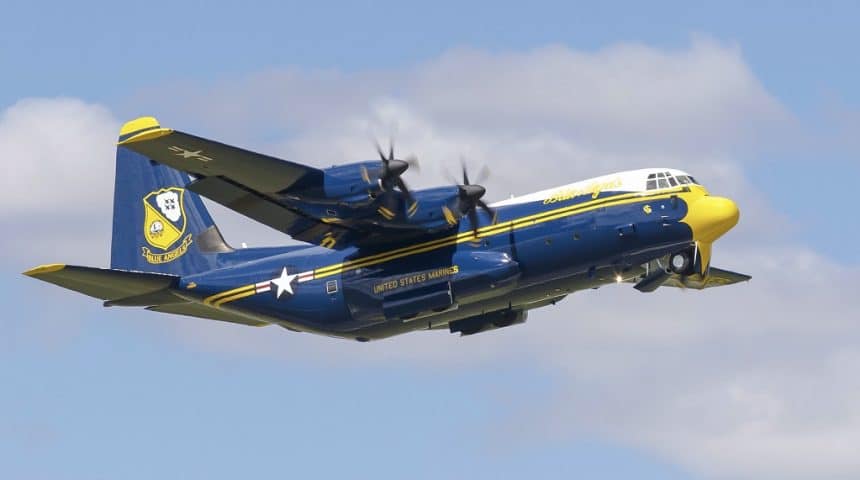
The team’s new C-130J performed a 4-hours Functional Check Flight from Cambridge in preparation for the ferry flight to the United States.
The Blue Angels’ new C-130J “Fat Albert” performed on July 20, 2020 the first Functional Check Flight (FCF) from Cambridge Airport’s runway 05, where the former Royal Air Force Hercules C5 ZH885 was refurbished and repainted by Marshalls Aerospace (the same company that repainted the Voyager KC2 ZZ336 “Vespina”).
The pilots are now in the process of performing a series of post-maintenance tests and FCFs, before finally undertaking the transatlantic flight that will take the new “Fat Albert” to Naval Air Station Pensacola, Florida, home of the Blue Angels.
Good Morning, #BAFans!
Your C-130 pilots and are currently performing their first functional check flight (FCF) in our new C-130J this morning over England!#BlueAngels #USMC #SemperFi #USNavy #ForgedByTheSea pic.twitter.com/z6tz9wonmS
— Blue Angels (@BlueAngels) July 20, 2020
This first FCF, which was visible on ADS-B tracking websites, lasted a little less than four hours and was performed in the airspace above RAF Marham, at various altitudes (from 9000 ft to 20000 ft) and speeds (from 140 kts to 340 kts), probably to check handling characteristics and all the onboard systems after the long maintenance works. The Hercules used the callsign “BUNO170” from Bureau Number 170000, the new serial that it was issued after the acquisition.
The new #BlueAngels “Fat Albert” C-130J BuNo170, former RAF Hercules C5 ZH885, currently performing the first Functional Check Flight from Cambridge. (screenshots via #RadarBox24/#adsbexchange) #avgeek pic.twitter.com/Y0DLUnYJOo
— Stefano D’Urso (@stedur93) July 20, 2020
As you may already know, the U.S. Navy retired last year the former “Fat Albert” C-130T Bu.No. 164763 that flew more than 30,000 hours with the Blue Angels since 2002, becoming famous also for the spectacular jet-assisted takeoff performed during air shows until the last JATO bottle stocks ran out (something that sadly we won’t see with the new “Fat Albert”).
NAVAIR (Naval Air Systems Command) chose to replace the C-130T with a divested UK aircraft because of the major cost savings and because due to the high operational tempo the Navy couldn’t take the replacement aircraft from the fleet. The Hercules was in storage as the RAF retired the standard C-130J (Hercules C5) and decided to keep in service only the longer C-130J-30 (Hercules C4).
While the aircraft was refurbished, the team’s pilots transitioned to the new Hercules variant and travelled to Cambridge, where the new livery designed for the “Fat Albert” C-130J was unveiled with some significant differences from the old one.