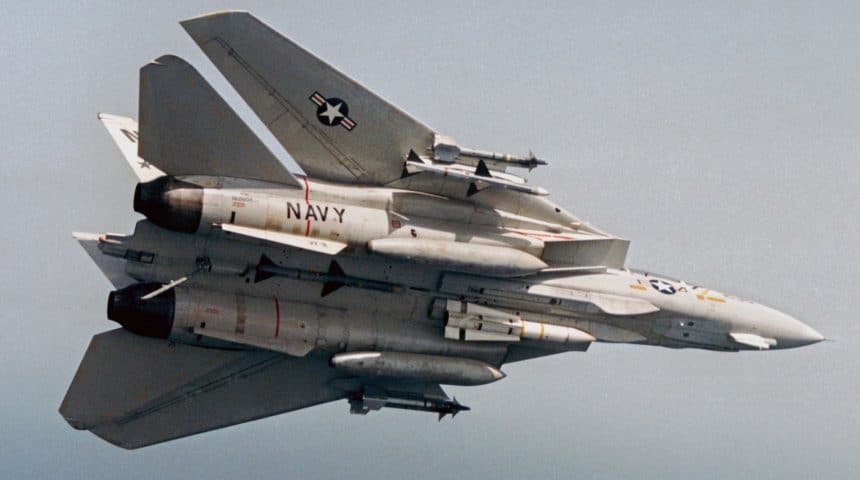
Strap into an F-14 Tomcat’s cockpit along with Tomcat RIO (Radar Intercept Officer) Dave “Bio” Baranek for an AIM-54 missile launch over the Pacific Ocean, 150 miles west of Los Angeles.
Dave “Bio” Baranek is probably the world’s most famous F-14 RIO after “Goose”, the character played by Anthony Edwards in Tony Scott’s original Top Gun movie. He was in the U.S. Navy for 20 years, spending 7 years, 3 months and 2 days at sea, and flying 2,499.7 F-14 Tomcat flight hours and 688 trap landings (including 249 at night). He served with VF-24, VF-2 and VF-211 (that he commanded) and was also a Topgun instructor.
Dave is also an accomplished author. We have already talked about “Top Gun Days” and “Before Top Gun Days” in the past. His third book, released earlier this year and titled “Tomcat RIO“, completes the trilogy of books about his experience in the Navy flying the Tomcat. The book takes you from the F-14 flying days after “Bio” left the Topgun school, all the way to the end of his career as Commander of an F-14 Tomcat Squadron.

Dogfighting, flying TARPS missions over the Persian Gulf, operating the LANTIRN pod, and taking part in real combat missions in support of Operation Southern Watch: “Tomcat RIO” has everything you want to find in a book about the F-14 and naval aviation. Including the first hand account of “Bio” firing an AIM-54 Phoenix air-to-air missile during an exercise off Southern California that you can find below!
And if you are interested in learning more about the F-14, join me and “Bio” on Facebook and Youtube, during our Live chat scheduled on Dec. 15, 2020, at 21.00CET – 15.00ET (you can also watch it later as it will be recorded!).
Tomcat RIO Chapter 1: “1,000-Pound Missile”
“FOX 3!”
Trying to control the excitement in my voice, I transmit the code words. My left thumb presses a red button marked LAUNCH. And one second later a mighty AIM-54 Phoenix missile drops from the belly of the F-14 Tomcat fighter. I can almost feel the plane’s relief as its half-ton, million-dollar hitchhiker roars away with its tail on fire and its radar nose sniffing out the target ahead.
I’d said those two words hundreds of times during my five years in the back seat of an F-14, flying as a RIO, a radar intercept officer. But those were training shots; nothing came off the jet. Before today, “Fox 3” meant I had targeted the adversary and could have punched the red button as a role-playing “enemy” jet streaked toward me, our two speeds adding up to a closure rate of 800 mph, maybe 1,000, maybe more. In the debriefing afterwards, the code would serve as a marker as we reconstructed the action.
Not today. This time it’s totally different.
I’m flying with Jeff “Moon” Mullen, a lieutenant with three years in Tomcats, one of the junior pilots in Fighter Squadron 2 (VF-2 in Navy terms). I’m also a lieutenant, but a “mid-level” officer because it’s my second tour of duty in a fleet F-14 squadron. Moon is easygoing and unassuming, but very serious about his job. This missile exercise, called “missilex,” is a workout for me as RIO, but he’s as focused as I am.
I’m Bio. My last name rhymes with “bionic,” but that got shortened to Bio and it stuck.
We’re in airspace designated for live missile launches, about 150 miles west of Los Angeles, with nothing below but the empty Pacific Ocean. Range control makes very sure that no other aircraft strays into the airspace. No ships or boats, either.
We’ve arrived early and are orbiting at 300 knots until the C-130 Hercules cargo plane gets here with our target. We’re shooting at a drone—unmanned, of course; it’s a live missile exercise. There’s a detailed schedule, and everyone is very professional—they do this all the time—but my internal clock is running about double speed as the drama builds.
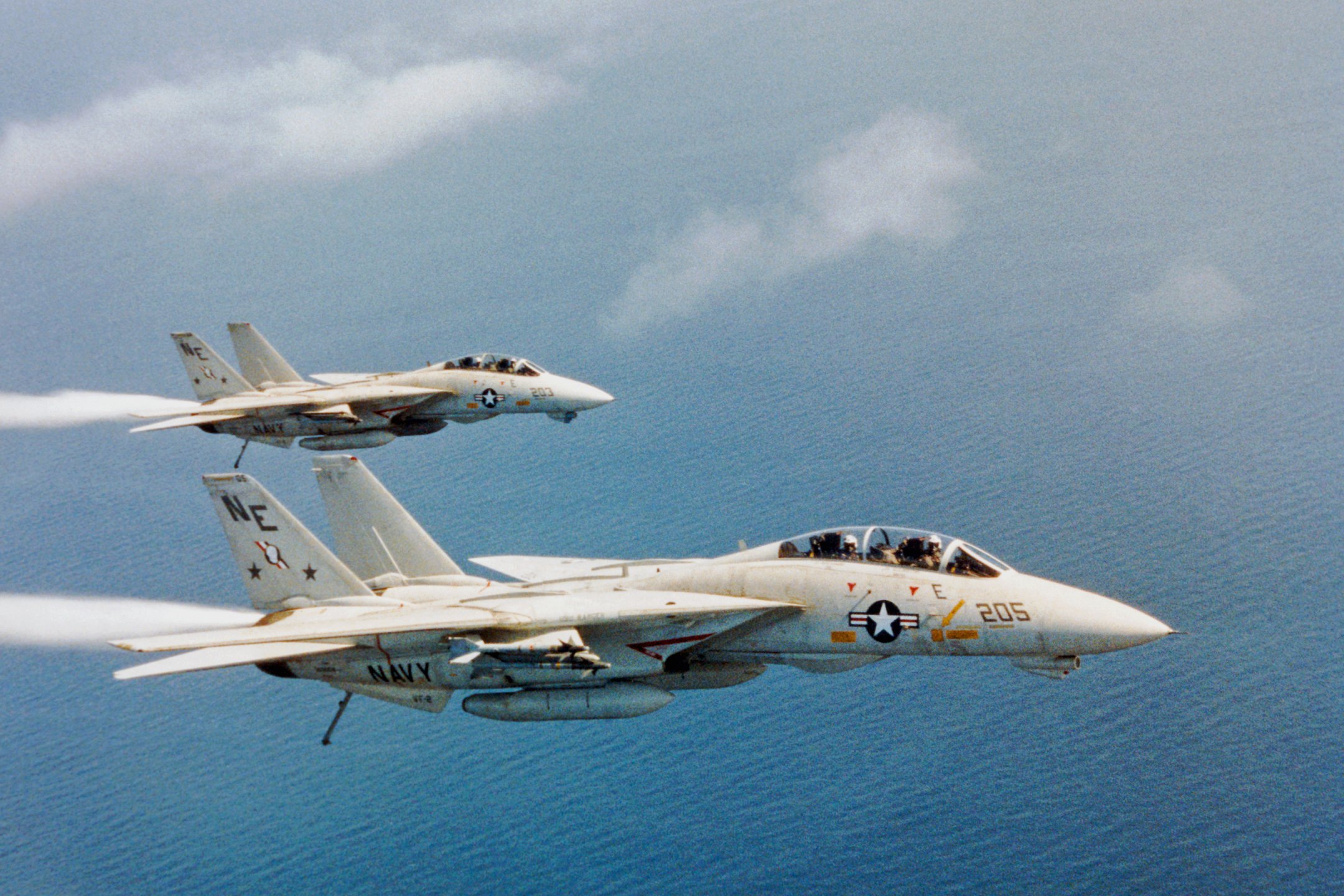
Now the C-130 arrives and turns south. You know the feeling: all is running smoothly, something’s about to happen—but when? We’re calmly circling, circling—and suddenly the intercept controller lights the fuse: “C-130 is steady, heading one-four-zero. Bullet two-zero-five, your contact is three-one-seven at seventy-two miles. Red range. Recorders on.”
I reply, “Two-zero-five coming left to three-one-zero. Red range.”
The “red range” means don’t launch the missile yet; the Hercules with people in it is still in the danger zone. So we start the run with a long setup of 72 nautical miles. My system is working perfectly, and as we turn northwest a symbol appears on my radar display. Its bearing and distance match the call from our controller, so I know it’s the C-130. I’m building a decision matrix, and this correlation is a key element.
We’re level now, at 20,000 feet. We accelerate to 450 knots—that’s a mile in about twelve seconds—with a live AIM-54A Phoenix strapped to our belly. We know the deadly Phoenix can fly—and kill—from farther away than any other air-to-air missile of its day, but today’s shot will be only twelve miles, so the missile will use its brain more than its legs. Our missilex is designed to check out some of the exotic moves this world-class weapon can do. Can it punch through an enemy’s radar jamming? We’ll see.
We’re racing toward the launch point when a voice from the C-130 alerts us. “Stand by for launch. Target away!” A new symbol pops up on my display as the old symbol—the C-130—high-tails it for shore.
Back on land, omniscient in his range control center, a radar controller sees all, knows all, and calmly updates us all. “Green range,” he says as the C-130 flees the scene. “Bullet two-zero-five you are cleared to arm, cleared to fire. Target bearing three-two-zero at fifty-two miles, heading one-four-five.”
Now it’s Moon on the intercom: “Master Arm on, Bio. AIM-54 selected. Looking good up here,” he says. We haven’t said much in these few minutes, but we’re both on the same page. In the F-14 Tomcat, the pilot flips the master arm switch to enable a weapons launch. Master arm—what a great name for a switch!
“Two-zero-five, green range,” I confirm. “Contact three-two-two at fifty.” Slightly different numbers from the controller’s call, but things changed quickly.
The target accelerated after launch, and now its speed combined with ours adds up to a closure of 1,000 knots; that’s one nautical mile in less than four seconds. But it’s way below us, flying as planned at only 100 feet above the water. The information on my radar confirms that I’ll have to manage a three-dimensional intercept. “Moon, come right to three-four-zero,” I tell him. The pilot flies the plane, but in an intercept, the RIO runs the show.
We’re closing fast. At 30 miles, here it comes; the target is trying to jam my system, confusing it with a barrage of radar gibberish. I can see it on my display, and I push a button to counter it. We trained for this in simulators, and I’m glad we did, because out here there will be no do-overs. This is the real thing: real target, real Tomcat, real missile.
Well, not quite. Our missile’s 135-pound warhead has been replaced with a telemetry package for today’s event. This is a test shot and the engineers want all the data they can get.
“Twenty miles, start the descent,” I say. Moon points the nose down ten degrees, as we practiced. It actually feels steeper than it sounds.
Things are happening fast now. I check and recheck the essentials: radar and switch settings, intercept angles and speeds and altitudes, and the letters PHA for “Phoenix, AIM-54A” glowing on the Weapon Selected display. As planned, we’re in a 10-degree dive, because the target is far below us. Suddenly my red Launch button lights up; the weapons system is telling me we’ve closed to a valid launch distance. The button is located in a low corner of the instrument panel, but it gets my attention. At 13 miles I tell Moon to stand by. A heartbeat later I punch the button. “Fox 3!”
It takes one second for the airplane to tell the missile everything it needs to know. Then powerful explosive charges blow the missile off its rail. As it leaves the plane, I add, “Op away,” a standard radio call for a missilex, to let controllers know it’s on its way.
The big Phoenix falls free for a few feet, then the rocket motor fires. My brain is at hyper-speed. I recheck the displays and switches. And finally I let myself look outside. Over Moon’s shoulder I see the fearsome missile roar away, trailing a vivid orange flame. It rises above our nose for a moment, then dives and speeds away.
If the human brain has a “save” folder, that brief video clip went straight into it. Those fleeting seconds are surely one of the coolest sights of my entire career! Here’s my camera, brought along for just such a moment, but I didn’t even try for a photo. The one in my head is enough.
Moon eases the dive, and we level off around 2,000 feet. He rolls to the right a little so we can both see the action. The target is streaming a tail of smoke to help us spot it, and the Phoenix is scribing its own smoky signature. In a few seconds the missile has dusted off the drone. I see a slow-motion eruption of flame, but that’s only in my mind. In the real world it’s just a close fly-by.
“Oh! That was good!” Moon yells.

“Intercept,” says Range Control, calm and professional. I can almost hear him yawn. Then he vectors us to two other jets that have already shot at their targets, and we join up and go home to Miramar. Below us, the Phoenix goes for a swim, having sent its precious data and done its job well. Our target drone pops its parachute and turns on its radio beacon, to be recovered and used again. Jammer, smoke, parachute—those target drones are impressive little machines!
Back on the ground, Range Control tells us that our missile zipped past the target with a scant six feet to spare. Given a warhead and proximity fuse, scrap metal would have rained into the Pacific today.
Today? This adventure was on a sunny afternoon in March 1988. Moon and I had carefully prepared for that flight. We’d “flown” the mission at Miramar in computer-driven simulators, detailed mockups of the F-14 Tomcat’s front and rear cockpits. I’d flown in real Tomcats for more than five years, so the simulators that would have thrilled any kid were, to me, well, boring. But once we started practicing the profile for our missilex, I put on my game face.
This was the Cold War era, and our forces had already seen how Soviet aircraft could send out false signals to fool a missile’s radar and kick it off course. I had to learn to recognize an unusual pattern on my radar scope and route the info to the missile, while controlling the radar intercept to get us into firing position. Moon and I had to work as a team, and the payoff was that scant six feet. No boom, no flame— but hey, six feet at a thousand miles an hour! In the air, as we confidently approached launch range, I was happy we’d run those boring simulators.
We almost got the real boom and flame that day. The day was a two-fer; we took off that morning carrying an AIM-9 Sidewinder with a live warhead to shoot down, for real this time, an unmanned QF-86 target. It was an obsolete F-86 fighter, the once-awesome Sabre jet from the 1950s, and despite its years, its shining silver finish was gorgeous.
We got into position to take the shot several times, but our cockpit display showed we were outside the launch envelope, and we didn’t want to screw up. We later learned that the missilex planners wanted us to shoot outside the envelope—but they never said, “Take the shot!” So we were denied the memorable sight of an exploding fighter. We returned to Miramar to refuel, shook it off, and came out for the afternoon missilex.

What a day! It happened about a year after I came back to flying F-14 Tomcats, after two and a half years flying in the relatively simple, agile F-5 Tiger II as a Topgun instructor. It was great to be back in Tomcats, and once again be part of a fleet Tomcat squadron!
The shot that afternoon enters the books as a “lethal miss.” But it enters this book as an adventure, a lesson both in the air and on the ground, a favorite file among many unforgettable entries in my cranial save folder. My time in VF-2 was full of adventures and lessons, and it set a course for the remainder of my Navy career.
Training and practice, plans and simulators, briefings and debriefings—and then the booms and the flames and the white knuckles as the make-believe becomes real. Strap yourself in and come along on the flight of a lifetime!