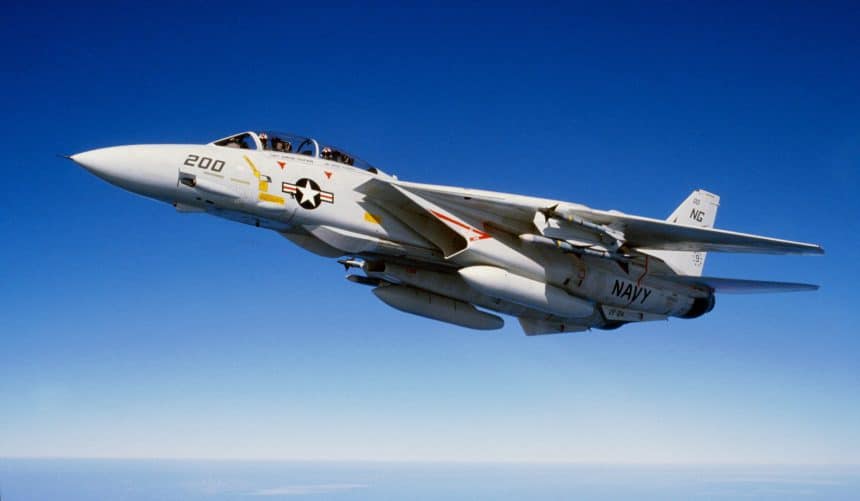
We celebrate the 50th Anniversary of the legendary F-14 Tomcat with an intense story from the cockpit of a 2 vs UNKNOWN engagement during Week Two at “Topgun”, the U.S. Navy Fighter Weapons School.
On Dec. 21, 1970, the first Full Scale Development (FSD) Grumman F-14A Tomcat (BuNo 157980) took off for its very first flight from Grumman’s flight test centre at Calverton, on Long Island.
Although the poor weather conditions forced the two test pilots flying the first “Turkey” (as the aircraft would be later nicknamed), Grumman chief test pilot Robert K. Smyth and project test pilot William Miller, to cut the maiden flight short, that date marks the beginning of the amazing career of one of the aviation most iconic fighters ever. A career that has seen the U.S. Navy’s premier air superiority aircraft become a Hollywood star, a reconnaissance platform as well as a combat proven strike fighter.
To celebrate the 50th Anniversary of the Tomcat below you will find an excerpt from Chapter 7 of “Topgun Days”, by Dave “Bio” Baranek.
Even if most of our readers already know him, in case you’ve never heard about him, here’s how I’ve described him in a recent article:
“Bio” is probably the world’s most famous F-14 RIO after “Goose”, the character played by Anthony Edwards in Tony Scott’s original Top Gun movie. He was in the U.S. Navy for 20 years, spending 7 years, 3 months and 2 days at sea, and flying 2,499.7 F-14 Tomcat flight hours and 688 trap landings (including 249 at night). He served with VF-24, VF-2 and VF-211 (that he commanded) and was also a Topgun instructor.
Dave is also an accomplished author. His third book, released earlier this year and titled “Tomcat RIO“, completes the trilogy of books about his experience in the Navy flying the Tomcat. The book takes you from the F-14 flying days after “Bio” left the Topgun school, all the way to the end of his career as Commander of an F-14 Tomcat Squadron.
“Top Gun Days” takes readers along with Bio as a new radar intercept officer (RIO) in his first F-14 squadron, and later when he becomes an instructor at the Topgun school. This chapter describes part of Bio’s experience going through the Topgun class as a student. Here he begins the second week of intense training and flying. It’s September 1982…

WILD CARD BOGEYS
My return flight from the Tailhook convention left Las Vegas Sunday morning. I was re-immersed in Topgun by way of a 6:00 AM brief on Monday, but one of the great things about being a lieutenant is that 6:00 AM is doable, even on a Monday after a weekend in Vegas.
The intensity and pace established in Week One continued. Pay attention and try hard or get left behind. They never actually “failed” anyone or sent them home, but we didn’t know that. Besides, I’m sure everyone in the class had coveted a seat in the Topgun class since their early days flying fighters (if not before). We all wanted to do well, and this was the best flying we’d seen.
The Topgun syllabus used a building block approach and progressed rapidly after the 1v1 flights through 1v2 (a real challenge), 2v1, and 2v2. The heart of the course was a series of 2vUNK flights—two fighters versus an unknown number of bogeys. We all said, “two-vee-unk.” We eventually flew several complex 4vUNK flights and a giant 8vUNK simulated strike.
As the scenarios evolved, I expanded my sphere of tactical concern outward from my own cockpit, beyond the 1v1 space, to encompass several aircraft and consider our mission.
The 2vUNK is a realistic and valuable training scenario. On the fighter side, the basic unit for combat employment of Navy fighters is a section composed of lead and wingman. The value of a second fighter was borne out repeatedly, so the Navy almost never assigned a single fighter to a combat mission.
On the bogey side, in the real world you rarely knew for sure how many you were facing. Despite the quality of E-2 or ship-board radar controllers, despite the fighters’ ability to sanitize airspace, despite the enemy aircraft you may kill before the merge, if you were over enemy territory and you were engaged, additional enemy fighters could show up at almost any time. This happened in combat, so Topgun trained us for it.

Unexpected enemy aircraft could appear while fighters were running an intercept, with the RIOs looking at their radars and pilots setting up a tactical formation, everyone thinking 15 to 30 miles ahead. If a bogey got into firing position during the intercept it could land a sucker punch. To help pilots and RIOs be ready, Topgun used the “wild card,” a bogey that could jump the fighters during their intercept, before the merge. (This is completely different from how the term is used in the movie, where a wild card is an undisciplined pilot. For example, Jester describes Maverick by saying, “He’s a wild card, flies by the seat of his pants.”)
After the wild card was introduced on the third section tactics flight, we had to be prepared for them on most flights, so Boomer, Jake, Jaws, and I worked them into our game plan.
After the 1v1 flights and 1v2, we flew with Boomer and Jake on every flight, taking turns as flight lead and wingman. Once an intercept developed, we could switch tactical lead and wingman roles based on factors such as one aircraft having a significantly better radar picture, or a change in our relative positions as we swept through the sky toward the merge. We briefed the ground rules for these changes and used radio calls to accomplish them. We soon became a close team of four instead of just two.
Jake and I already got along well, having known each other from Pensacola, which gave us three years of friendship including many evenings at O-Clubs and other social venues.
Jaws and Boomer didn’t have a long personal history and were more competitive than Jake and me. Very talented pilots who showed true mutual respect, they also got into energetic discussions about fighter tactics and how our section should operate. But disagreements took place only when it was just the four of us. The instructors and other class fighters didn’t see or hear any of it. Each of us knew that we would do better if we worked closely and smoothly together instead of one trying to rise above the others.
For me, it was impressive to watch the self control exhibited when we transitioned from “private” to “public” environment. The public mode included the classroom, briefing and debriefing, and any time in the aircraft. Even if we did not all agree on something, we were always calm and mutually supportive when others were around. It was a ground-based example of not leaving your wingman, to use a phrase emphasized in the movie
By Week Three our section was well sorted-out, having gone through a lot of group dynamics in Week Two. All four of us knew our individual roles and we had honed our teamwork to a lethal level. Simulated lethality, of course.
On Wednesday morning of Week Three, a few minutes after 11:00 AM, we were holding west of the TACTS Range. Jaws and I had the lead, with Boomer and Jake as wingman. We were in loose formation at an altitude of 22,000 feet, flying at max conserve airspeed waiting for another section of fighters to finish so we could take our turn on the range.
We had launched a few minutes early, but rather than just kill time waiting, we switched the front-seat radios in both jets to listen to the other section. I don’t know if anyone else did this, but it was standard procedure for us. We heard the fighters ahead of us run intercepts, call missile shots, and get engaged at the merge. We sometimes heard their communications deteriorate into yelling because of frustration, anger, or both. Yelling on the radios sounded really bad.
This experience, coming just moments before we were to enter the same arena, always proved valuable. It helped our section prepare mentally and gave us fresh incentive to remain calm and professional.
The other section knocked off their last fight and headed for Yuma to refuel and debrief. After what I heard on the radio, I wouldn’t want to be in that little room. We reset our front-seat radios to the section tactical frequency, and on the backseat radio I called, “Topgun Three and Four at Telegraph Pass, ready for weapons checks.” Telegraph Pass is a visual landmark at the northwest corner of the range, where the fighters usually waited. We coordinated with our controller to verify that our TACTS pods were working.
Our controller said, “Bogeys on station, ready.”
Having done this about two dozen times in Topgun, our section was ready by this point so I replied, “Fighters are ready.”
The controller immediately said, “Recorders on, fight’s on. Bogeys 108 degrees at 36 miles, 22 thousand, headed northwest.” Their altitude of 22,000 feet would surely change as the bogeys used common tactics such as changing altitude to try to confuse us.
As we completed our left turn, Jake and I had both slewed our radars as far as possible to the side to point toward the threat. I was searching medium-to-high altitude, he was searching medium-to-low. For initial detection I used a long-range automatic mode, and almost immediately saw radar contacts. I reported this as, “Jaws contact that call. Fighters steady one-zero-zero.” On a mission like this we used the pilot’s callsign for our aircraft. My directive call to the pilots (fly a heading of 100 degrees) was more important than the target location at this point. This was something all RIOs are told starting in Pensacola and graded on at the RAG. Now at Topgun it was hammered home—during the intercept the lead RIO has to direct the fighters.
The radar placed a small target symbol on the nine-inch TID in front of me. Jaws had the same picture on his screen, but he was not looking at it. We had talked about all of this in setting our contracts, including our lookout and information gathering responsibilities during portions of the intercept.
I took two seconds to look high over my left shoulder and then throw my head to look high over my right, scanning for a wild card. We were not pulling g’s so it was easy to look around, but a wild card would be hard to see against the bright midday sun. Nothing up there. Jake was doing the same in his jet. I returned to my radar.
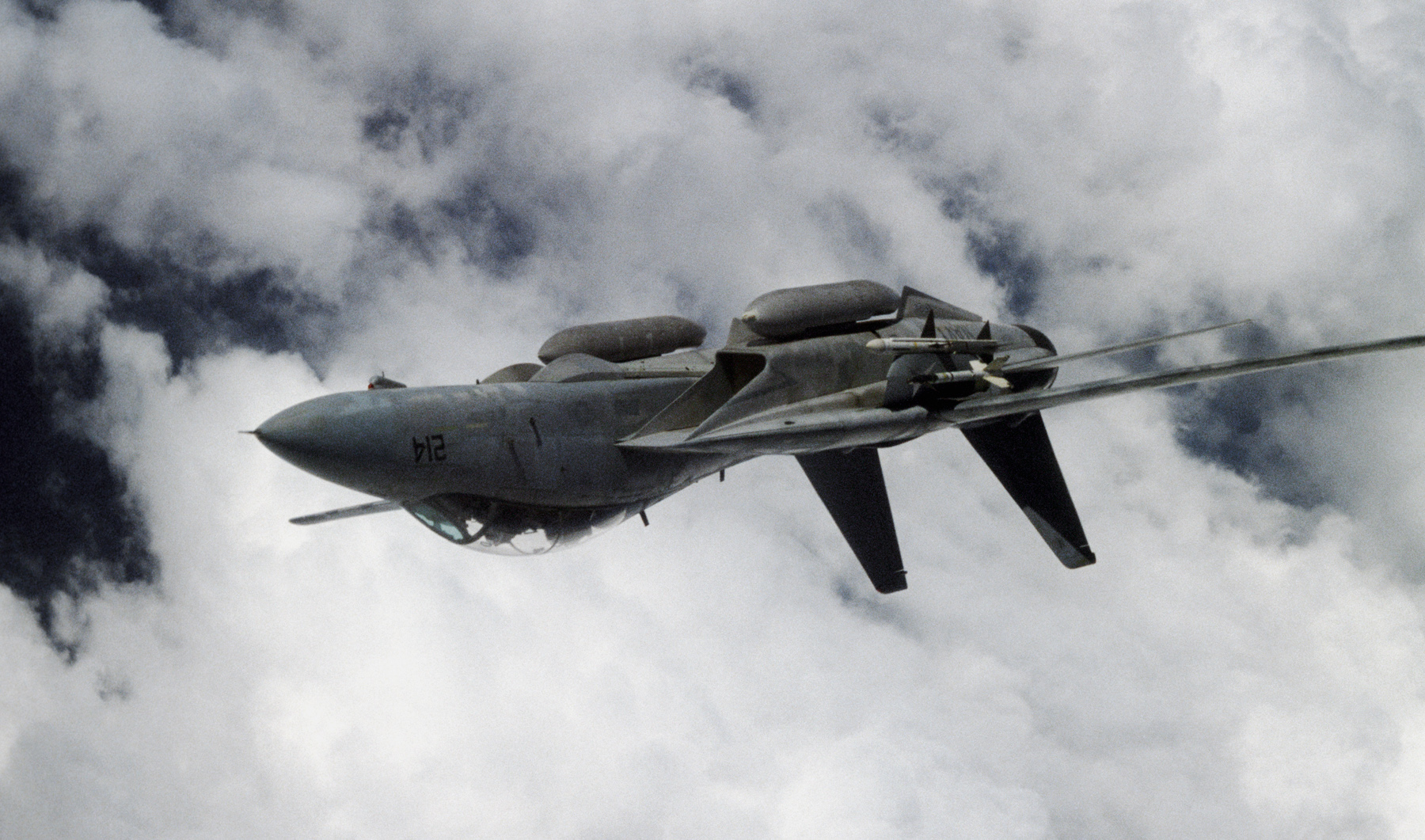
I noted bogey altitude, about the same as ours, and with my left hand reached up to push a square button on the panel in front of my face to switch the radar to a manual mode (pulse search, which showed objects at their bearing and range from our aircraft). With my right thumb on a small roller on the antenna control stick on the center console I set antenna elevation, and adjusted other knobs to enhance the radar picture. These actions were subconscious by now. I leaned forward to squint at the other radar display in my cockpit, a four-inch wide scope in front of my face that displayed raw radar; the glowing green screen displayed black blobs representing mountains, and I discerned several well-defined black dots, which were aircraft. “Jaws, single group, 108 at 32,” I estimated over the radio. It was still early in the intercept so I didn’t have to be too accurate.
I reached up and switched back to the auto-track mode (track-while-scan, auto). I told Jaws about my radar mode switches. If I was having problems, he would suggest a possible solution, but this run was going fine so far.
“Boomer same,” Jake said. He saw the targets that the controller and I called, and had no additional bogeys in his altitude block.
We were flying about 350 knots, the bogeys about the same, for a closing speed of 700 knots. This was the slow part of the intercept.
It was now thirty seconds after the fight’s on call.
“Jaws, 112 at 30, 22 thousand, heading west, speed 350.” My radar was automatically tracking one target and occasionally showed another symbol, but it couldn’t yet distinguish the additional targets. I didn’t need any new directive calls at this time. We were headed roughly east (100 degrees), accelerating through 400 knots, with Boomer and Jake on our left side about 1½ miles away. Every few seconds I looked for a wild card.
On the ICS I told Jaws, “I see additional targets in pulse, but they’re just a gaggle.”
“Roger.”
I looked up and left again, then right, then said on the radio, “Jaws, hard right, tally, right five high!”
I’d spotted a bogey—a wild card—about 10,000 feet above us, just beginning his attack.
Jaws added power and pulled our jet into a 4-g turn to the right, abandoning the intercept to deal with the immediate threat. Boomer did the same and started to go nose low so both fighters were not in the same piece of sky. Four sets of eyeballs looked high and to the right.
After 30 to 40 degrees of turn we heard over the radios, “Fighters continue.”
Yes! That was the instructor in the wild card jet. We had seen him early enough to meet the training objective, so now we could turn our attention back to the intercept.
Over the radio I said, “Jaws left, steady 110.” Estimating we were about 25 miles from the bogeys, I wanted to get them on radar and re-assess. The AWG-9 lost the target in the turn but displayed an estimated location that agreed with my mental plot, so I pointed my radar in the that direction.
In just a few seconds the target re-appeared. “Jaws, single group, 115 at 22 miles, come left 090. They’re at 18 thousand, let’s go down.”
Jake answered, “Boomer, second group in eight-mile trail.”
We immediately recognized this tactic from our classes. While we were dealing with the wild card, one or two bogeys flew a tight delaying turn that put them about eight miles behind the lead. This would complicate our decision making. We couldn’t dogfight the first bogeys or those in the second group would easily shoot us, but we couldn’t ignore the lead bogeys either. Using Phoenix missiles we could each assign missiles to some targets, then attack the others with our other weapons, but Phoenix missiles were not an option in this scenario, so we had a real challenge. As briefed, Jake now focused his radar on the second group.
We were now inside of 20 miles to the lead group. Jaws descended to 16,000 feet and leveled off. I switched again to the manual radar mode and got an accurate look at the bogey formation. Both the fighters and the bogeys accelerated so we were now approaching each other at one mile every four seconds.
On the radio I said, “Jaws, lead group is lined-out right, 18 miles, 18 thousand.”
Jake said, “Boomer, trailers at 25 miles.” It sounds like a sizeable distance, but things would happen so fast in the next minute that I was feeling the tension. It was not uncomfortable, just exciting. We were completely prepared for this.
I switched back to track-while-scan and adjusted the scale of my display. The radar took a few sweeps to process information, about six seconds that seemed like minutes, and now we were 13 miles from the lead group. On the ICS I said, “Jaws, look at the TID.”
We had worked out a plan based on the theory that a picture is worth a thousand words. For most of the intercept to this point Jaws had been looking outside the aircraft. When we had 15 miles to the merge I set up a picture on the display that he could see—the tactical information display—and told him to look. When I did that, he said, “Boomer is at left eight low,” using the common clock code.
Jaws looked at his display to get the tactical picture, and I looked outside to locate our wingman. He said, “Got it,” and I said, “Visual,” so we both accomplished what we intended.
Turning back to the radar, I designated the lead target symbol with the hand controller and pushed the single target track button. Above the scope two small green lights indicated a radar lock, which would allow us to shoot a missile. Over the radio I said, “Jaws locked lead, ten miles, lined-out right.”
“Boomer, trailers at 16 miles, 15 thousand, line-abreast.” So the second group sped up a little and they were a little below us.
Jaws turned our fighter to the right to put the targets on the nose. He looked through the head-up display (HUD) on his windscreen, and a green diamond showed the target location based on our radar lock. Jaws had good vision and called, “Speck in the diamond.” This let everyone know he could see something where the bogeys were supposed to be, which was good.
I divided my attention between ensuring the radar lock stayed good, checking Boomer’s position, checking fuel, and actually making notes for the debrief. If the radar hiccupped I could manually get another lock, but that didn’t happen this run.
“Fox One, lead A-4, 18,000 feet.” Jaws squeezed the trigger on his stick to simulate launching an AIM-7 Sparrow radar-guided missile. A tone indicated the shot registered on the TACTS Range. He identified the target as an A-4 to show he was not just taking a wild shot.
For the next thirty seconds, things happened fast and there was a lot of information to process. Boomer made a radio call that he saw both bogeys in the lead group. Jake made a radio call about the trail group and took a radar lock. I updated Jaws on Boomer’s position (left nine o’clock low, one mile). The bogey we shot was deemed dead by the TACTS controller. Jaws selected a Sidewinder heat-seeking missile, got a tone, and called a shot on the second bogey in the lead group. The controller relayed that that shot was a kill as well, so the lead group was gone. Jaws gave Boomer the lead to get us to the trailers, only eight miles away now. I went to the radar and got a lock on the second bogey of the trail group.
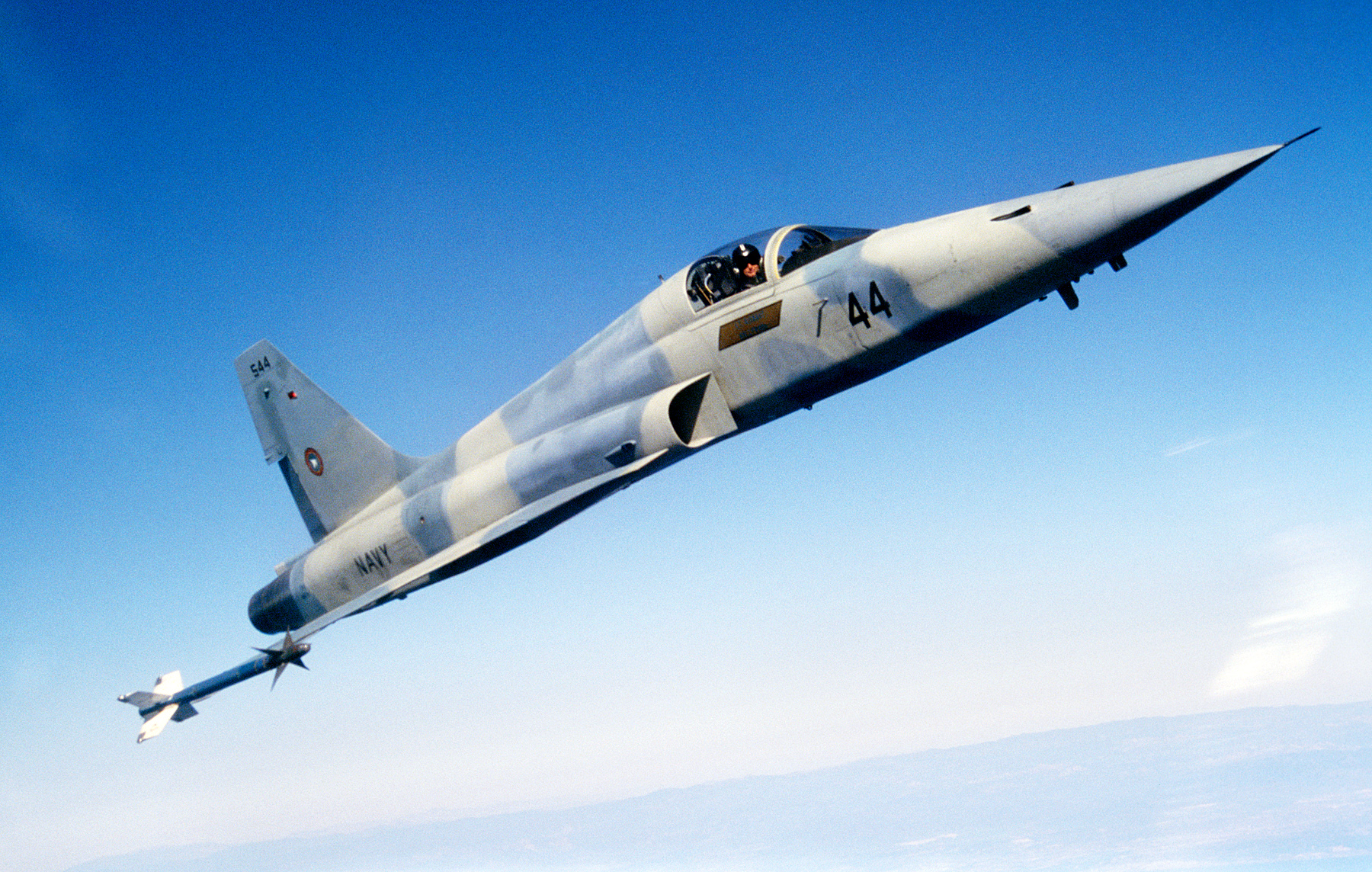
“Fox One, northern F-5, 15,000 feet.” Boomer had identified and shot one of the trailing bogeys. On his call the entire formation was considered hostile so Jaws also launched a missile.
“Fox One, southern bogey that group.”
The TACTS controller announced both bogeys killed, and then said, “Knock it off, knock it off.”
“Jaws knock it off.”
“Boomer knock it off, state 10.8.”
Damn, that was cool! I thought.
Over the ICS Jaws said, “Nice work, Bio!”
We flew back to Telegraph Pass and set up for the next run. On the second run we did not have a wild card. Instead, that aircraft flew with the other bogeys so we had a 2v5. We also did not get kills on every shot before the merge, so we had some great engaged time.
We then flew a third engagement, a short setup of about 20 miles.
On one of these runs we bugged out at low altitude. In looking around, I saw mountains ahead of us. Jaws was comfortable with where the jet was going, so he looked back over his shoulder and saw me looking forward. When he looked back I actually said, “Watch the mountains!”
He came back, “Watch the bogeys!”
And so we added another rule to our contracts. On a bugout, when we left an engagement as quickly as possible, he could trust me to check behind us for bogeys, and I could trust him to watch terrain. Afterward, I never checked on Jaws because I didn’t look forward on bugouts anymore. Since we never hit anything I believe he kept his part of the contract.

We landed at Yuma to refuel, grab lunch, and debrief, then went out for two more 2vUNK flights that day. All three flights lasted 1.0 (one hour), and reinforced what I had learned with John Boy just one year before, that most 1.0s are great flights.
And that was just one day out of five weeks! Now I knew why guys were so enthusiastic about going through Topgun.
If you want to learn more…
If you want to learn more about the F-14, take a seat and watch this recent 2-hour interview to Bio.
You will learn about the F-14A, enjoy a tour of a Tomcat RIO cockpit, understand how the TARPS pod operated and why the TCS (Television Camera Set) was of little tactical value to “Bio” compared to the LANTIRN pod.
You will also hear Baranek recall his days as a Topgun instructor, take part in the filming of Top Gun movie and ejecting after a trap landing on USS Constellation in the Indian Ocean in 1981.