Following the F/A-18F Super Hornet and the E-2D Advanced Hawkeye, the unmanned MQ-25 tanker was now tested in conjunction with the F-35, moving at a fast pace towards the delivery of a fully mission-capable drone.
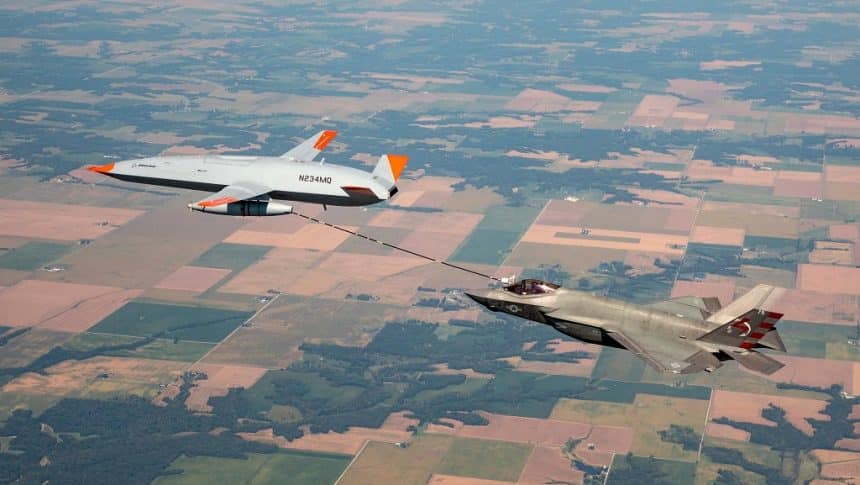
The U.S. Navy announced a few days ago the latest milestone of the MQ-25 Stingray unmanned tanker program, with the drone refueling for the first time the Navy’s newest fighter aircraft, the F-35C Lightning II. The successful test was conducted on September 13, 2021 near MidAmerica St. Louis Airport in Mascoutah (Illinois) and involved the Boeing-owned MQ-25 test asset, known as T1, an F-35C from Air Test Wing and Evaluation Squadron Two Three (VX-23) and an EA-18G Growler of the same unit as safety chase.
“Every T1 flight with another Type/Model/Series aircraft gets us one step closer to rapidly delivering a fully mission-capable MQ-25 to the fleet,” said Capt. Chad Reed, the Navy’s PMA-268 program manager. “Stingray’s unmatched refueling capability is going to increase the Navy’s power projection and provide operational flexibility to the carrier strike group commanders.”
Developing the #AirWingoftheFuture
The #USNavy completed the first aerial refueling of an #F35C Lightning II by the @Boeing MQ-25, a broader initiative to field unmanned systems to enhance capability, capacity and lethality. #FlyNavy #MQ25
DETAILS: https://t.co/WG0A8CnWaj pic.twitter.com/K692RT8DlR
— U.S. Navy (@USNavy) September 14, 2021
This event marked the third refueling flight for the T1 test aircraft, following the first refueling flights with an F/A-18F Super Hornet in June and with an E-2D Advanced Hawkeye in August. Each aircraft type is aerodynamically unique so they will respond differently to the wake of a tanker and these flight tests are needed to assess how they will interact with each other and the refueling system. As we already reported, the MQ-25 employs the Cobham Aerial Refueling Store (ARS), the same used by F/A-18s, to perform the refueling operation.
During the three-hour flight, as disclosed by the Navy, the F-35C approached T1, performed formation evaluations, wake surveys, drogue tracking and plugged with the MQ-25 test asset at 225 knots calibrated airspeed (KCAS) and altitude of 10,000 feet. From the ground control station, an air vehicle operator then initiated the fuel transfer from T1’s aerial refueling store to the F-35C. The data collected will now be analyzed to determine if any adjustments to guidance and control are required.

The F-35C test will be the last land-based refueling test for now, as the Navy’s press release mentions that T1 will now enter into a modification period to integrate the deck handling system in preparation for a shipboard demonstration this winter. The MQ-25 T1 test asset has so far conducted 36 flights for a total of more than 120 flight hours, providing the program with valuable information on aerodynamics, propulsion, guidance and control in advance of the MQ-25 engineering and manufacturing development aircraft deliveries.
As we already reported, the MQ-25 T1 is the predecessor to the four engineering development model (EDM) MQ-25 aircraft being produced, the first of which is expected to be delivered later this year. The U.S. Navy is planning to procure more than 70 aircraft, which will replace the F/A-18E Super Hornets in the aerial refueling role they currently have as part of the Carrier Air Wing, becoming also the first operational carrier-based UAV. This way, the Carrier Air Wing will have more Super Hornets available for operational mission, without the need to reserve some of them for the air-to-air refueling mission.
Later this year, the U.S. Navy will stand up Unmanned Carrier-Launched Multi Role Squadron (VUQ) 10, the fleet replacement squadron; then, two MQ-25A squadrons, VUQ-11 and 12, will be established. These squadrons are set to deploy aboard U.S. Navy’s aircraft carriers. The MQ-25 will be the first operational carrier-based unmanned aircraft and will provide critical aerial refueling and intelligence, surveillance and reconnaissance capabilities to support the Air Wing of the Future – a mix of fourth and fifth-generation aircraft, manned and unmanned platforms, and netted sensors and weapons.
Along with organic tanking, the Navy mentions that the MQ-25 will pave the way for manned and unmanned teaming (MUM-T) of carrier-based aircraft that will extend the strike range and enhance maneuverability, possibly opening to new concepts in the future for carrier-based Loyal Wingman-type unmanned aircraft.