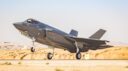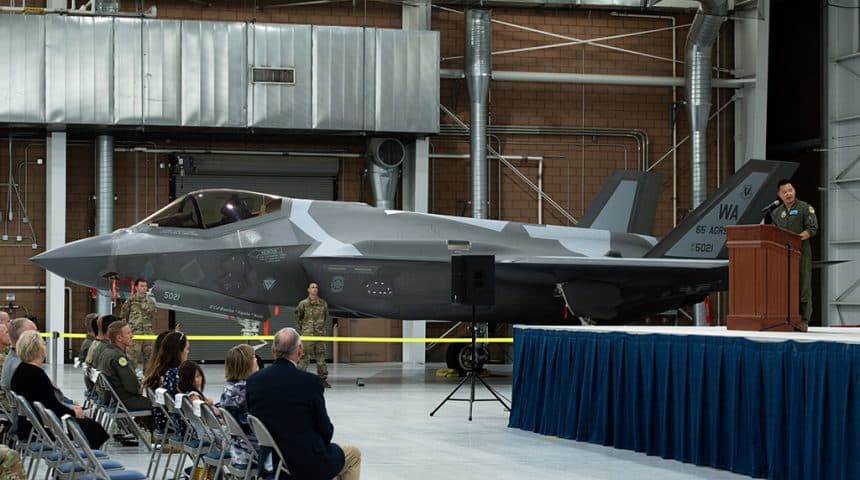
Here’s the first Aggressor Lightning II of the 65th AGRS (Aggressor Squadron).
On Jun. 9, 2022, the U.S. Air Force reactivated the 65th Aggressors Squadron at Nellis Air Force Base, Nevada. The unit, apreviously flying the F-15C/D, inactivated on Sept. 26, 2014, due to Fiscal Year 2015 budget constraints but a plan to “resurrect” it and move 11 F-35A Lightning IIs from Eglin AFB, Florida, to Nellis, “as part of a larger initiative to improve training for fifth generation fighter aircraft” was announced on May 9, 2019.
“Due to the growing threat posed by PRC fifth- and sixth-gen fighter development, we must use a portion of our daily fifth-generation aircraft today at Langley, Elmendorf, Hill, Eielson, and now Nellis, to replicate adversary fifth-generation capabilities,” Air Combat Command commander Gen. Mark Kelly who flew his F-15E Strike Eagle against the unit’s first assigned F-35 and newest commander, Lt. Col. Brandon Nauta, immediately prior to the reactivation ceremony, said. “Precisely because we have this credible threat, when we do replicate a fifth-gen adversary, it has to be done professionally. That’s the Aggressors.”
The emergence of a “stealth threat” among the near peer adversaries was the reason for choosing early production F-35s, aircraft that would be too expensive to upgrade to a mission capable status, for realistic training of U.S. and allied 4th and 5th generation pilots against low-observable threats similar to what Russia and China are developing.
According to the U.S. Air Force, the F-35s will be employed into large Combat Air Forces exercises, U.S. Air Force Weapons School missions, joint exercises, and operational test and evaluation events that are only conducted at Nellis Air Force Base and the Nevada Test and Training Range.
“This significant milestone marks our ability to bring fifth-generation capabilities to the high-end fight, and will allow us to enhance our premier tactics and training with joint, allied and coalition forces,” said Brig. Gen. Michael Drowley, 57th Wing commander.
“Using the F-35 as an aggressor allows pilots to train against low-observable threats similar to what adversaries are developing,” said Col. Scott Mills, 57th Operations Group commander.
Aggressor jets are quite popular for sporting eye-catching paint schemes that replicate the camouflage, markings and insignas of Russian and Chinese combat aircraft, so that pilots in training who come within visual range of these adversary jets get the same sight they would see if they were engaging an actual threat. And, as The Aviationist reported in an exclusive story in September 2020, the F-35 are going to be painted with threat representative color schemes.

In a story that appeared online on Sept. 10, 2020, we also published seven artistic renderings made by Sean Hampton of current Aggressor camouflage schemes sported by 64th AGRS and 18th AGRS’ F-16s, applied to the F-35. As we explained back then, Sean submitted other liveries that are not based on existing Viper camouflages but decided not to release them until the squadron have their unveiling of the chosen schemes.
Here’s a comment this Author added to the article about the renderings:
While we don’t have any idea [as to whether] a camouflage color scheme will ever make its way to an F-35 since the LO (Low Observability) coating is one of the aircraft’s most delicate components and, for the moment, no F-35 was ever given anything more exotic than the standard haze paint of the stealth aircraft and some high-visibility tail markings, these ones, inspired to some pretty popular paint schemes, like the “Wraith“, “Ghost“, BDU Splinter, etc, are truly amazing.
“The current plan is to seek ACC approval to use a threat representative color scheme on the Aggressor F-35s”, told us the 57th Wing PAO Media OPS in an email in September 2020. […] At the moment it is unknown whether the color scheme will be made using paint or decals” the spokesperson added.
And this is the comment this Author wrote in the article that broke the news of the F-35 getting an aggressor paint scheme:
Therefore, there is a plan to give some peculiar threat representative color scheme to the Aggressors F-35, although the thing still need to be approved. It remains to be decided what kind of scheme will make it to the Nellis airframes.
To preserve the LO, the Aggressor paint scheme should be made of a combination of colors approved for use on the F-35. Currently, just 6 Federal Standard Paint colors should be approved for use on the type. However, the Air Force could expand the color palette for these aircraft, considered that they are non-combat coded jets so they’re not held to the stringent rules other F-35s are. It basically depends on how much LO they want to preserve.
At the same time, the use of decals seems less likely: there have been some vinyl-wrapped tails in the past, but for longevity (and considering that decals affect the Low Observability too), it would most probably be paint, possibly a more “toned down” scheme than one of the seven eye-catching ones of the renderings submitted by Sean Hampton.
In the end, the F-35A indeed got a toned-down scheme with three shades of gray that seems to use existing panels painted a lighter gray than the rest of the aircraft, resulting in the peculiar livery. The characteristic saw tooth panel lines of the first type of F-35 coating are quite evident in the nose section.
Let’s wait for some images of the aircraft “flexing” on departure from Nellis AFB to catch some more details about this paint scheme and, above all, let’s see what kind of camo scheme will other F-35s receive.