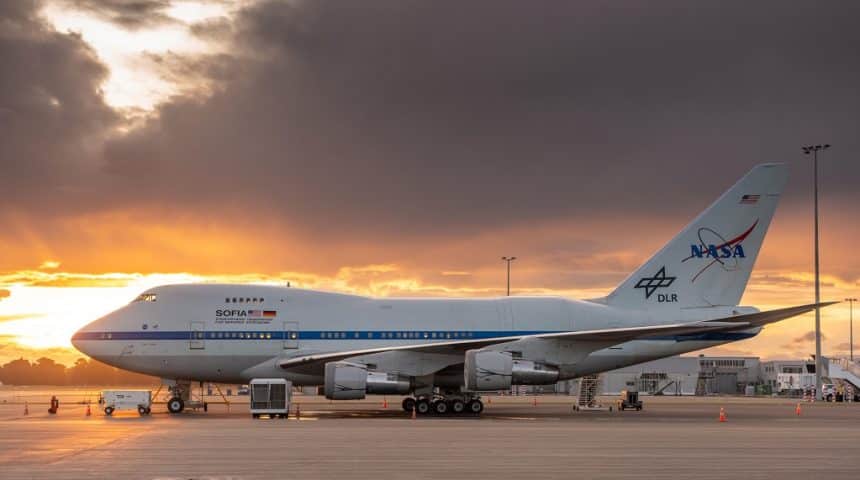
The SOFIA (Stratospheric Observatory For Infrared Astronomy) aircraft leaves an important legacy of science and engineering.
As announced earlier in 2022, with the end of this fiscal year, NASA retired, on September 30, 2022, its Boeing 747SP Stratospheric Observatory for Infrared Astronomy (SOFIA). The aircraft performed its assigned mission until the end, landing after its final scientific flight on September 29 and leaving an important legacy of science and engineering. Throughout its eight years of activity, SOFIA helped reveal unseen parts of our universe and helped to better understand its origin.
“From deepening our understanding of water on the Moon to revealing the invisible forces of cosmic-scale magnetic fields, none of it could have happened without the hundreds of people who contributed their expertise to the SOFIA mission,” said Naseem Rangwala, the mission’s project scientist at NASA’s Ames Research Center in California’s Silicon Valley.
The aircraft was the result of one of the many engineering marvels at NASA. When the development started in 1996, it was decided to modify the former Pan Am Boeing 747SP (Special Performance) so it could carry the the 38,000-pound, 100-inch (more than 17,000-kilogram, 2.5-meter) telescope provided by NASA’s partner on the SOFIA mission, the German Space Agency at DLR.
This isn’t just a plane. It’s so much more.
The world’s largest flying observatory is entering retirement. Learn about the legacy of our SOFIA mission: https://t.co/WXUpj0UF9A pic.twitter.com/uN0CGYRTZt
— NASA Ames (@NASAAmes) September 29, 2022
The engineers at NASA’s Ames Research Center developed a garage door-like mechanism that rolled up to let the telescope observe the skies. In that configuration, it was “one of the largest open ports ever flown on an aircraft,” said Paul Fusco, a NASA engineer, now retired, who helped design the door system, “and the largest certified to fly at all altitudes and speeds with the door open. It was a really thrilling aviation innovation.”
One could ask how a telescope of that size was expected to work with all the vibrations and the other factor that generally should be avoided by astronomers working with these instruments. In reality, engineers achieved such smooth flight characteristics that pilots couldn’t even feel when the door was open and the stability of the telescope itself was “equivalent to keeping a laser pointer steady on a penny from 10 miles away”.
SOFIA’s FIFI-LS instrument can see two different wavelength ranges simultaneously. Because these each tell us different information, FIFI-LS has been used to study the Galactic Center, star formation, and more. #SOFIAFinalFlight pic.twitter.com/1GICxXashV
— SOFIAtelescope (@SOFIAtelescope) September 16, 2022
After 18 years, the Boeing 747 SOFIA finally reached its full operational capability in 2014. Over the next eight years SOFIA helped astronomers around the world use infrared light to study an impressive array of cosmic events and objects invisible to other telescopes, thanks to the aircraft’s capability to fly in the stratosphere and avoid the disturbances created by air in the troposphere, the lowest layer of the atmosphere that extends from the ground up to 18 km of altitude in average.

“SOFIA’s unique scientific achievements were the result of the ingenuity of the incredible international community that grew up around the mission,” said Alessandra Roy, SOFIA project scientist for the German Space Agency, “which was only made possible by the collaboration of NASA and DLR.”
Now, with the science flights coming to an end, NASA is exploring options for a fitting permanent home for this special aircraft. SOFIA’s data from a total of 732 nights observing over the course of its mission will also be publicly available for scientists to study and conduct further research in the future. Those flights were conducted not only out of the NASA Armstrong Flight Research Center in Palmdale, California, but also from various locations around the world, depending on the observations’ requirements.
In its lifetime, SOFIA made a total of 732 nights of observations. This map shows all of SOFIA’s science flights, color coded by observation cycle.
Map data ©2022 Google, INEGI Imagery ©2022 NASA, TerraMetrics pic.twitter.com/l5T7Al0KC5
— SOFIAtelescope (@SOFIAtelescope) October 11, 2022
“Infrared astronomy will go on at NASA, most notably with the James Webb Space Telescope,” said Paul Hertz, senior advisor for NASA’s Science Mission Directorate, former Astrophysics Division director, and former SOFIA program scientist. “But SOFIA’s many and diverse contributions to science have already left their mark.”
Flying at 38,000 to 45,000 feet, SOFIA soared above 99.9% of the water vapor in Earth’s atmosphere that obscures infrared observations from the ground. The telescope still peered through the upper reaches of our atmosphere, but it was able to help scientists discover many unknown aspects of the universe.
For an instance, although SOFIA’s telescope wasn’t originally configured to look at the Moon, its lunar observations confirmed, for the first time, water on the sunlit surface of the Moon. This meant water may be distributed across the lunar surface, and not limited to cold, shadowed places. This discovery is especially important as NASA is preparing to send humans to the lunar surface with the Artemis missions.
After decades of searching, SOFIA also detected, for the first time in space, the first type of molecule that ever formed in the universe. Many studies were allowed by the airborne observatory and focused on the atmosphere of planets, the distribution of gases in the universe and the search for water.