What’s It Like to Be Inside a WWII B-17G Flying Fortress? Come Inside for a Tour.
In a bizarre coincidence, at the same time the tragic events of the B-17G and P-63 midair collision was unfolding at the Commemorative Air Force Wings Over Dallas Airshow on Nov. 12, 2022, we were taking a tour of the new Yankee Air Museum’s Roush Aeronautic Center at Willow Run Airport in Ypsilanti, Michigan.



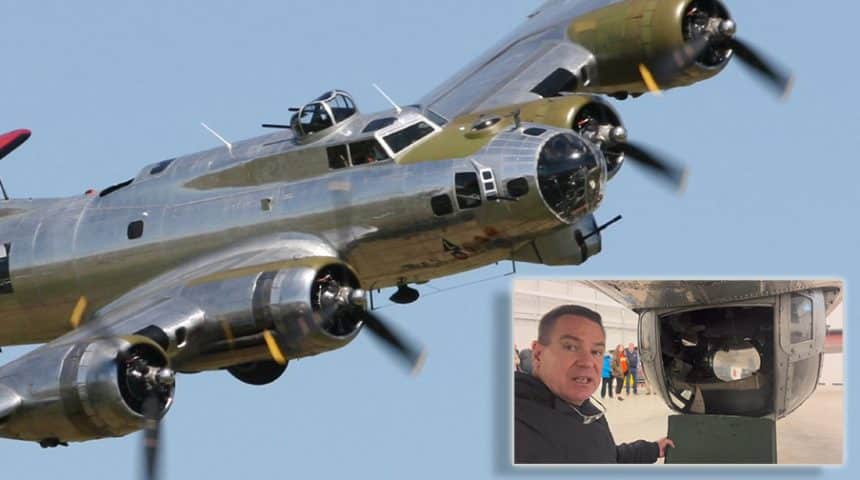
During this first-ever public tour of the museum’s new hangar and maintenance facility at Willow Run, we were able to make some videos of the interior of the Yankee Air Museum’s Boeing B-17G Flying Fortress, USAAF serial number 44-85829. In the wake of the tragic midair collision in Dallas on that same day, these videos provide a quick insight into what it’s like to be inside the B-17G Flying Fortress, the most recognized bomber of WWII.
As with all WWII aircraft, the interior is cramped and utilitarian. The Boeing B-17G Flying Fortress was an unpressurized aircraft. Flight crews wore electrically heated thermal F-1 or F-2 “Blue Bunny” suits under their heavy insulated flying pants and jackets. At altitude, above about 10,000 feet where most missions were flown, crews used oxygen masks that frequently collected frozen perspiration and mucus, then malfunctioned, putting crewmembers at risk of hypoxia. Crews also donned heavy flak vests and helmets when approaching a target where enemy anti-aircraft fire, or “flak”, and fighters were a threat.
My father helped design the B-17G when he worked at Boeing’s Renton plant near Seattle, Washington during WWII. The B-17G was an upgraded version of the previous B-17F version of the famous bomber. In response to the Luftwaffe tactic of attacking the formations of B-17s from the front due to less defensive armament facing the front of the aircraft, Boeing designed the B-17G with a chin-mounted turret under the nose of the aircraft. This new turret held two Browning M2 .50 caliber machine guns. Additionally, “check” turrets, fixed protrusions on each side of the nose, were added that held one .50 caliber gun each. These upgrades on the B-17G enabled the aircraft to carry a maximum defensive armament of up to thirteen .50 caliber machine guns.
While the B-17G did not have many crew comfort features, the aircraft quickly earned a reputation as being extremely durable and able to survive significant damage from anti-aircraft fire and from enemy fighters. Many B-17 Flying Fortresses returned to their bases in England after dangerous raids over Europe with wounded crewmembers and heavy battle damage. The ability of the B-17 Flying Fortress to bring crews home even when heavily damaged is one of the reasons the aircraft has become legendary.
Currently, there are about 40 B-17 Flying Fortresses on display or flying around the world. Most of these are restored, static display aircraft inside museums, such as the famous B-17F “Memphis Belle” at the Nation Museum of the United States Air Force at Wright-Patterson AFB near Dayton, Ohio. About nine B-17s were reported to be in flying condition prior to Saturday’s tragic accident in Texas.
Interestingly, aircraft like the Yankee Air Museum’s Boeing B-17G “Yankee Lady” are extremely safe to fly on because of FAA requirements for airworthiness for vintage aircraft and because the aircraft receives such regular and meticulous maintenance. The new Yankee Air Museum’s Roush Aeronautic Center was built predominantly for maintenance of the museum’s flying aircraft and provides a climate-controlled, ultra-modern indoor space for keeping the museum’s aircraft in excellent flying condition year-round.