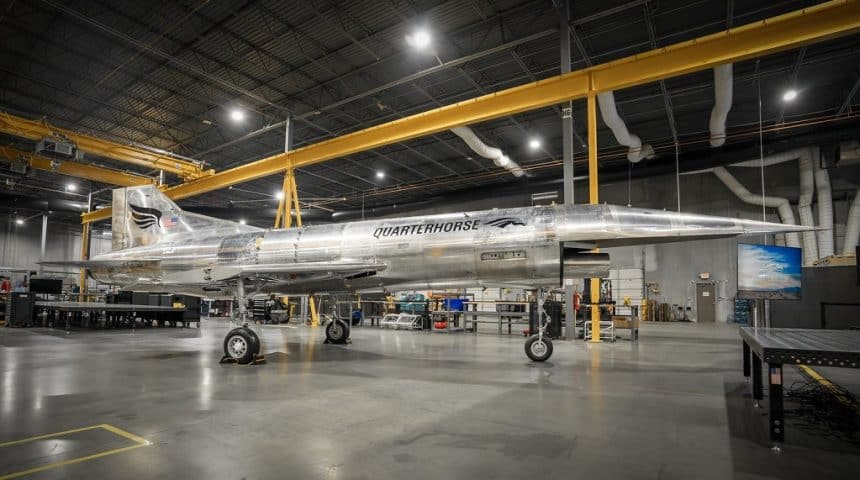
The company, that also shared plans for the next Mk 2 aircraft powered by the Pratt & Whitney F100 engine, aims for the final Quarterhorse Mk 3 to break the SR-71 flight speed record.
Hermeus, a US company aiming to develop hypersonic aircraft quickly and cost-effectively, has unveiled its first aircraft, Quarterhorse Mk 1, which will take flight later this year. Quarterhorse Mk 1 is a remotely piloted aircraft powered by a General Electric J85 engine (the same used by the F-5 and T-38) which will demonstrate high-speed takeoff and landing, a key enabling capability unique to future hypersonic aircraft on the company’s roadmap.
Hermeus, in fact, has laid out a development roadmap with an iterative design based on four aircraft, each with a specific purpose, with the ultimate goal of breaking the airspeed record held by the SR-71 Blackbird. Each aircraft will progressively increase in complexity allowing Hermeus to distribute program risk across multiple vehicles and accelerate learning:
- Mk 0: ground testing only, demonstrated remote command and control taxiing;
- Mk 1: the first flight vehicle, will demonstrate remote takeoff and landing;
- Mk 2: supersonic aircraft which will demonstrate automated supersonic flight below Mach 3;
- Mk 3: will demonstrate turbojet to ramjet transition and attempt to break the SR-71’s records.
The Mk 0 was designed and constructed within six months, and all test objectives were completed in just 37 days of deployed testing. Similarly, the Mk 1 was designed, built, and integrated in just seven months. Hermeus, in fact, has set the pace of one aircraft per year for the development of their hypersonic aircraft.
“The most unique and important aspect of our approach to developing a hypersonic aircraft is our rate of iteration – designing, building, and flying an aircraft in less than a year, every year,” said Hermeus CEO and Co-Founder, AJ Piplica. “It’s a pace that hasn’t been seen in the aircraft world for half a century. This approach has been proven successful in delivering massive improvements in the capabilities of rockets, satellites, and small drones. We’re now bringing that power of iteration speed to aircraft. It’s a capability that is absolutely necessary for solving the challenges of operationalizing hypersonic aircraft.”
Now that the assembly of Quarterhorse Mk 1 is complete, the development team is transitioning to the integrated test phase of the aircraft. The coming months will see the vehicle endure a battery of tests across its subsystems, ground station, operations, and human factors to prepare it for flight test later this year at Edwards Air Force Base, California.
“Moving into the integrated test program is the culmination of a huge team effort and a significant emotional event for the entire company,” said Hermeus Vice President of Test, Don Kaderbek. “As we begin the journey to first flight, we will conduct a comprehensive evaluation of the aircraft’s performance while simultaneously examining the effectiveness of our test procedures, safety culture, and interdisciplinary team collaboration. We’re excited and humbled to conduct this testing at the legendary Edwards Air Force Base”.


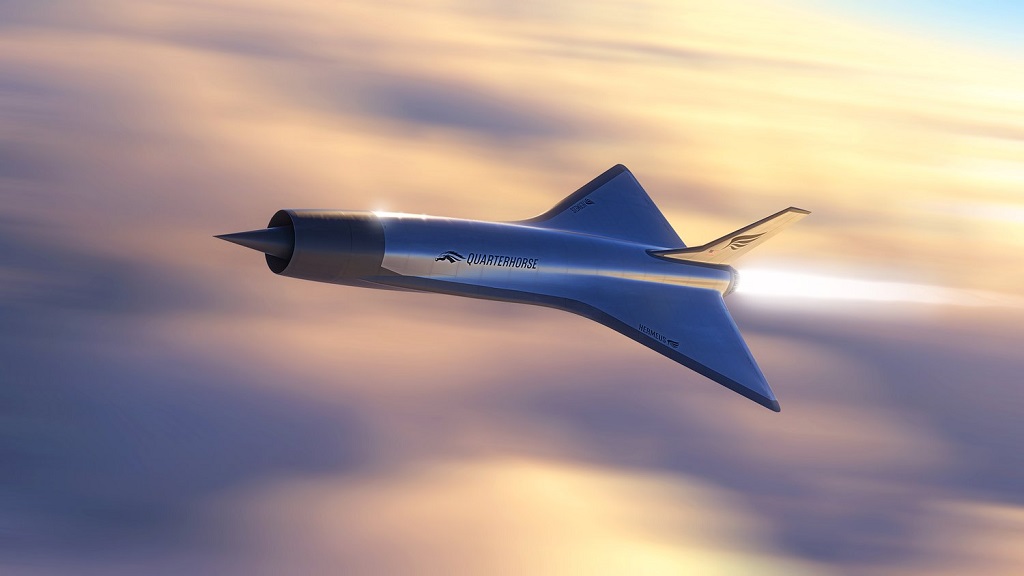
With the Mk 1 vehicle complete, Hermeus also shared details about the plans of the Mk 2, which resembles the D-21 drone which was paired with the A-12 (the SR-71’s predecessor) and is expected to start supersonic testing next year. The RPA will be powered by a Pratt & Whitney F100 engine, the same afterburning turbofan used on the F-15 and F-16, although the specific variant has not been disclosed.
“Pratt & Whitney and Hermeus share a foundational purpose, which is to deliver highly valuable military capability to further the United States’ combat and technological edge,” said Josh Goodman, senior director of the F100 Engine Program at Pratt & Whitney. “For 50+ years, the F100 has delivered. Hermeus is taking the engine’s reliable combat-proven experience and utilizing it in its propulsion solutions for both its Quarterhorse and Darkhorse programs. The F100 continues to find renewed relevance and we are excited to be a part of Hermeus’ visionary goal of developing platforms that will emulate legendary aircraft like the iconic SR-71.”
Beating the SR-71’s records is just the start for Hermeus, which also aims to mass-produce two other designs: Darkhorse, a multi-mission hypersonic drone designed for defense and national security missions (resembling Top Gun’s Darkstar), and Halcyon, a passenger aircraft capable of accelerating 125+ trans-oceanic routes at hypersonic speeds (with some resemblance to the XB-70 Valkyrie minus the canards).