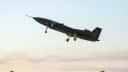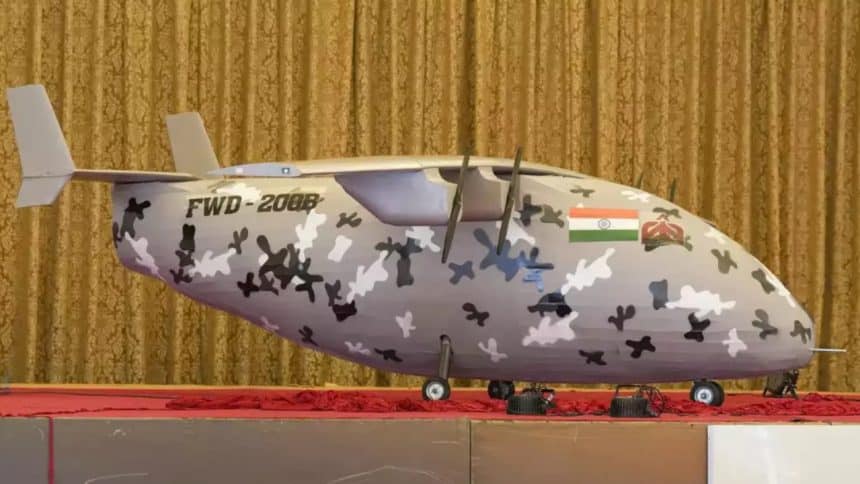
Compared to other MALE (Medium Altitude Long Endurance) drones, the FWD-200B features a pretty unusual shape, so to speak.
On May 3, 2024, Flying Wedge Defence and Aerospace Technologies, an Indian company based in Bengaluru, introduced the FWD-200B, a domestically developed unmanned aerial vehicle (UAV). The presentation of the new unmanned aircraft, said to be India’s “first indigenous bomber drone”, got a lot of attention on local media, which extensively reported about the features of the FWD-200B. We received a lot of inquires about it, so let’s have a closer look at it.
The company emphasized that the UAV would fulfil India’s requirement for a sophisticated unmanned combat aircraft, contributing significantly to efforts aimed at achieving self-reliance in a crucial segment of modern warfare.
‘Flying Wedge Defence 200B (FWD-200B)’, India’s first indigenous #Bomber UAV is unveiled by ‘Flying Wedge Defence & Aerospace Technologies,’ an Indian defence & aerospace startup.
With a 12-20 hour endurance, 370 kmph speed and 200 km range, #FWD200B is viewed as an indigenous… pic.twitter.com/lduNz92ijP
— Samir Dattopadhye (@samirsinh189) May 4, 2024
Established in 2022 by Suhas Tejaskanda, the company’s mission is to reduce India’s dependency on costly imported bomber UAVs, bolster the Make in India initiative, and position India as a global leader in drone manufacturing and technology, all while enhancing national security.
The Make in India initiative is a program launched by the Government of India in 2014 with the aim of encouraging domestic manufacturing and promoting investment in various sectors, including manufacturing, technology, infrastructure, and defense.
The initiative seeks to boost India’s manufacturing capabilities, attract foreign investment, and create job opportunities by facilitating ease of doing business, fostering innovation, and supporting the development of indigenous industries. The program focuses on promoting India as a global manufacturing hub and reducing reliance on imports by promoting the production of goods and services within the country.
India’s first indigenous bomber UAV unveiled in #Bengaluru
The FWD-200B is a medium-altitude, long-endurance (MALE) unmanned combat aerial vehicle designed and manufactured entirely in India.
All you need to know 🔗 https://t.co/Rlb6OJN9MG pic.twitter.com/ahRav8HHah
— The Times Of India (@timesofindia) May 3, 2024
Presenting the FWD-200D, Suhas Tejaskanda, the Founder of Flying Wedge Defence and Aerospace, said: “For over 15 years, India’s aspiration for combat unmanned aircraft remained elusive, despite substantial investments and previous attempts by DRDO with projects like Tapas and Rustom failing. Today, with the launch of the FWD-200B, India not only realizes this aspiration but also joins the ranks of nations with advanced combat aircraft capabilities.”


Following the unveiling of a full-scale model of the UAV, Tejaskanda outlined plans to conduct the aircraft’s maiden flight in May. The company is actively engaging with the Army Design Bureau (ADB), which spearheads the Indian Army’s Make in India initiative, and aims to market the FWD-200B to countries currently purchasing high-priced UAVs like the Predators.
Tejaskanda emphasized the cost-effectiveness of the FWD-200B compared to its counterparts, stating, “While the US Predator costs a staggering 250 crores [about 33M USD/29M Euro], our indigenous FWD-200B, equipped with state-of-the-art technology and manufactured in India, slashes the cost to a mere 25 crores [3.3M USD/2.9M Euro]. This not only underscores our commitment to self-reliance but also positions India as a leader in cost-effective defense solutions.”
Indian alternative to American Predator drone.
Now india will make bomber Drone by itself. no need to bargain to buy american military bomber drones.
FWDA Launched India’s first indigenous bomber Drone -(FWD-200B)
FWD-200B Design and Origin
Capabilities of FWD-200B
Strategic… pic.twitter.com/ZIYc1KrQCG
— Civil Learning (@CivilLearning1) May 4, 2024
According to the reports in the Indian media, the bomber UAV boasts a payload capacity of 100 kg and is classified as a MALE Unmanned Combat Aerial Vehicle (medium-altitude, long-endurance).
Equipped with optical surveillance payloads and integrated with missile-like weapons for precision air strikes, the FWD-200B can achieve a maximum takeoff weight of 498 kg and has a ground control station (GCS) with a range of 200 km. It has a maximum speed of 200 kts/370 km/h and an endurance of 12-20 hours.
The company’s website lacks information on this type of drone. Actually, most of their products appear to consist of standard quadcopters designed for diverse applications, alongside conceptual military projects presented solely as renderings.
That being said, what really impresses about the FWD-200B is its rather unusual shape.
The shape of the FWD-200B
Generally speaking, the design characteristics of modern MALE UAVs reflect a balance between endurance, payload capacity, operational flexibility, and mission effectiveness. Modern MALE drones share some common characteristics including:
- A wing design optimized for endurance and efficient cruising.
- The airframe is designed to minimize drag and enhance aerodynamic efficiency, allowing the UAV to achieve extended endurance. Some types are designed to reduce the drone’s RCS (Radar Cross Section)
- The MALE UAVs are generally larger and heavier compared to smaller tactical UAVs (like those presented every now and then by other Indian start ups), enabling them to carry larger payloads and accommodate more fuel for longer endurance.
- All modern drones incorporate advanced communication systems for beyond-line-of-sight control and data transmission. These systems enable operators to control the UAV remotely and receive real-time sensor data and imagery.
While there are many peculiar designs in the world of MALE UAVs, the FWD-200B is probably the most surprising one: I’m really curious to understand how it will be able to soar, if it maintains this shape and, above all, this wingspan (something that I consider quite unlikely). The landing gear also seems to be extremely small for that fuselage while the engines are not made in detail but only hinted at.
It seems reasonable to believe that (at least) a completely different type of wing (with a significant wingspan) and a more robust landing gear will be required by the FWD-200B to be able to take off and land safely. Still, someone noted that, despite the domestic hype, it’s not the first time a start up in India presents an UAV with bold claims that, in the end, does not turn up into anything real. Let’s see.
To be honest, if it weren’t for the fact that some reputable Indian media reported about it, you won’t be reading this article now.