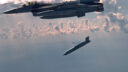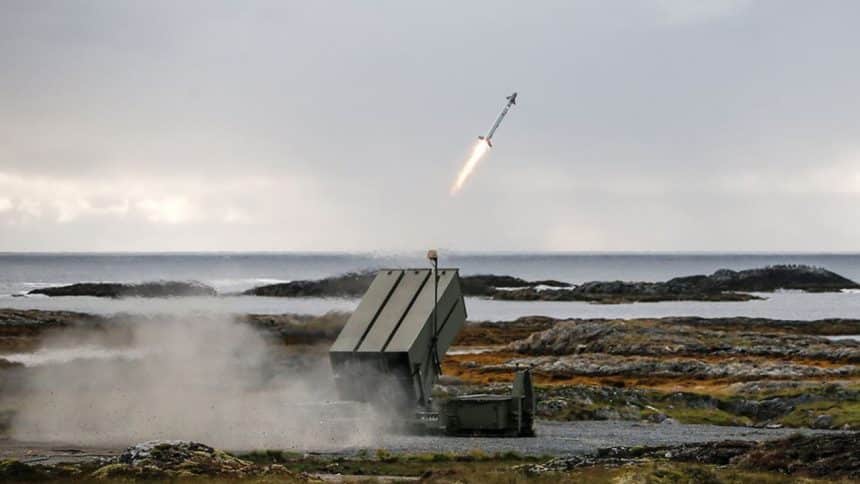
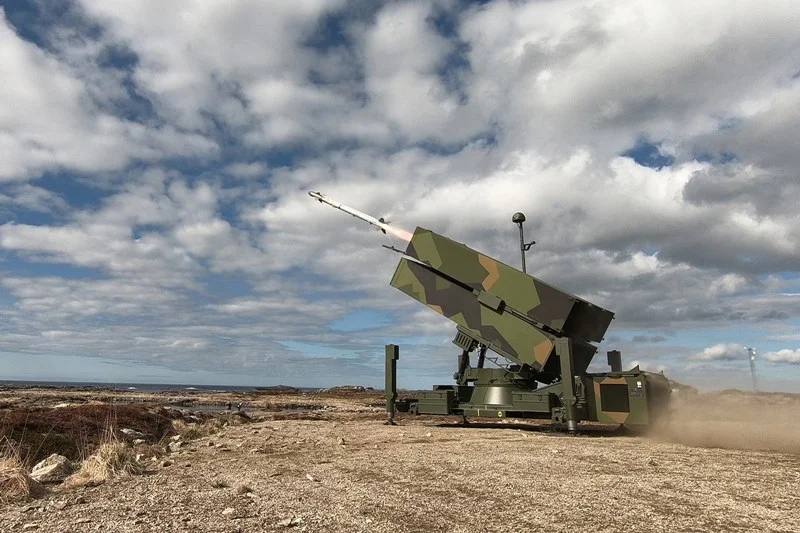
Recently released footage shows an AIM-9X Sidewinder missile being fired from Ukrainian NASAMS fire unit.
Ukraine has begun using the AIM-9X Sidewinder AAM (Air-to-Air Missile) as a ground-launched AD (Air Defense) missile from the NASAMS (National Advanced Surface-to-Air Missile System), going by a promotional feature released by Ukraine recenlty.
In a clip, the missile goes on to destroy the target in a WVR (Within Visual Range) engagement, consistent with its orientation as a short-range anti-aircraft air-launched missile.
The missile’s operation is shown as a part of an eight-and-a-half minute long news feature about United24, about Ukraine’s air defense efforts before Russia’s missile barrages. The feature begins with the missile leaving the six-canister launcher and quickly turning direction to end in a fireball. This indicates an aerial target has been intercepted.
Militarnyi reported that the NASAMS 3 system was used in the firing. Only this version of the system can fire the ‘X’ variant of the AIM-9 (AIM-9X).
“We have (shot down) 252 confirmed targets, including 114 drones and 137 cruise missiles,” said “Baron,” an officer interviewed as a part of the news feature.
The high interception rates however also come with a downside of expending those many missiles. As will be explained subsequently and stated by the subjects themselves in the feature, the missile’s service essentially represents an industrial issue, where replenishing it is difficult, while Russia’s military factories are churning out arms unabated.
⚡🇺🇦💪🚀💥Ukraine has received the AIM-9X Sidewinder RVV for use with their NASAMS SAMs.
The AIM-9X is the latest version of the AIM-9 and confirms that Ukraine has received the most advanced NASAMS 3 SAMs. pic.twitter.com/TwblEF9qGl
— 🇺🇦 UkraineNewsLive🇺🇦 (@UkraineNewsLive) May 28, 2024
AIM-9X – AAM-Turned-SAM
The AIM-9X is a short-range air-to-air missile with an infrared homing warhead, suited for intercepting high-pressure aerial targets. When launched from the ground, this missile’s range is however limited to 12-km. Ukraine also uses the original NASAMS, that fires the AIM-120 AMRAAM (Advanced Medium-Range Air-to-Air Missile). It was developed jointly by Norway’s Kongsberg and Raytheon (now RTX).
The ‘X’ is the most advanced version of the AIM series of short-range AAMs in the US inventory. A product of RTX, it has a solid-state infrared homing system. It also features a high off-boresight focal-plane array seeker mounted on a highly maneuverable airframe with a greatly improved infrared counter-countermeasures feature. It has an advanced ‘Block II’ subvariant that entered full-rate production in September 2015. A ‘Block III’ iteration too is under development.
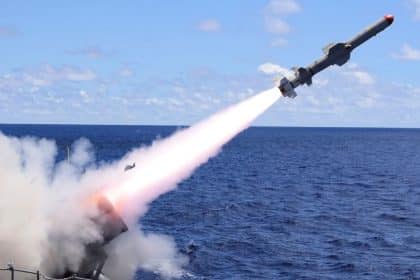
“The AIM-9X incorporates many AIM-9M legacy components (rocket motor, warhead and active optical target detector), but its performance far exceeds the legacy Sidewinder. Unlike previous AIM-9 models, the AIM-9X can even be used against targets on the ground,” according to NAVAIR (Naval Air Systems Command).
The missile and the launcher have also been fused before, when in May 2019, the Royal Norwegian Air Force tested an AIM-9X Block II from a NASAMS at the country’s Andoya Test Range.
War of Mass Manufacturing
The video has Ukrainian military personnel speaking in the background – as the AIM-9X hits the target – about that being the third target being shot down. The identity of the target is not known. But Russia usually uses a combination of coordinated long-range stand-off missile fires.
These include the Kh-101 ALCM (Air-Launched Cruise Missile) fired from the Tu-95 and the Tu-160 strategic bombers; the Iskandker and Iskander-M battlefield tactical missiles; the Kinzhal aeroballistic hypersonic missile and the Geran-2 (or Geranium-2) derived from the Iranian Shahed-136. These projectiles are fired in coordination across the nearly 965-km frontline into Ukrainian rear military targets or power-generation and civilian-military targets into its cities.
A previous analysis, based on Western reports, showed how even rising shoot downs of Russian drones and cruise missiles, while being celebrated by the Ukrainian Air Force, was also exhausting its stock of Western SAMs. This was then concluded to be a Russian strategy of allowing the tactical losses of its missiles for the larger strategic goal of depleting Ukraine’s Western missiles.
Three aspects put this phenomenon in perspective. One, the missiles were neither manufactured nor assembled in Ukraine. Its defense industry too is unable to undertake any large-scale production of capital weapons, as most of it has been destroyed by Russia in its officially stated “demilitarization” goal. Secondly, these missiles come from US and European NATO militaries’ own armories, which is effectively weakening them further. Moreover, the current defense industrial problems in the US and Europe, that currently cannot undertake large-scale mass arms production for conventional wars, are only beginning to be addressed.
It will be a while until their private arms industries’ new factories and manufacturing lines approved over the last year will be up and running. Even then, it is possible that the factories might be flooded with orders to replenish their militaries’ original inventories that were emptied after donating to Ukraine.
‘Russia Overwhelms AD Systems’
“Baron” himself touched upon this state of affairs. While highly rating the Russian and Soviet SAMs and revealing he commanded the “seriously” effective S-300 once, he said he would still prefer Western systems like the Patriot, NASAMS, or the IRIS-T. But he added that Russians are now “selecting one, two or three targets and carrying out a combined strike exclusively at them, rather than attacking everything at once.”
“They simply overload the air defense system,” he added. The narrator then touched upon the “lack of air defense systems and the missiles for them in Ukraine.” “Over the last six months” there were instances where Baron’s unit “saw targets but had nothing to shoot them down with.” Baron said earlier in the interview that sometimes they “loaded the launcher twice” during an enemy strike.
Their “record” is “16 launches in one battle,” of which they “destroyed 12 targets.” The “juiciest target” is the “Kh-101.” The heavy-hitting ALCM that has been recorded to have variants releasing decoys and sporting dual warheads – possibly developed and fielded during the war.
“There were times when nine cruise missiles were flying towards me and I only had three shots left,” Baron added. But the “Russians have a trump card,” which is the “missile stock.” “They can even afford shooting at (Ukrainian) artillery with anti-aircraft missiles.” Think tanks like CSIS (Center for Strategic and International Studies) and Atlantic Council have noted that Russia’s defense production remains largely unaffected, as the Western sanctions have had limited impact.