After the start of the E-7A Rapid Prototype program in 2023, the Air Force has now ordered the first two aircraft that will be produced as part of the effort.
Boeing announced on Aug. 9, 2024, that it has received a $2.56 billion contract from the U.S. Air Force for the production of two rapid prototype E-7A Wedgetail AEW&C (Airborne Early Warning & Control) aircraft. This contract is the continuation of the E-7A Rapid Prototype program that the service started in 2023 to develop a replacement for the aging E-3 Sentry AWACS (Airborne Warning and Control System).
Boeing added that the contract also includes lifecycle development, training and support for the Air Force’s E-7A fleet. The E-7 was selected in 2022 to replace the E-3, leading to the establishment of the E-7A Program Management Office and, a year later, to the first contract to Boeing to develop two new variants of the aircraft.
“Global operators are proving that the E-7 AEW&C is a critical node for air superiority in the modern battlespace,” said Boeing Vice President and E-7 Program Manager Stu Voboril. “In our partnership with the U.S. Air Force, we’re focused on stable, predictable execution to deliver crucial mission-ready capabilities today. This will put us on the path for the long-term growth of the aircraft and mission.”
The E-7 Wedgetail
Built on the Boeing 737-700 NG airframe, Boeing says the E-7 AEW&C aircraft offers lower operating and sustainment costs, higher mission readiness rates and unmatched interoperability among a growing global user community. In fact, using the Boeing 737 NG platform allows to capitalize on the existing aircraft design, certification and modification processes which, together with a well-established supply chain, will reduce development, maintenance and logistics costs as well as the time needed before it can be fielded.
The aircraft was initially developed for the Royal Australian Air Force under “Project Wedgetail” and later adopted by the Republic of Korea Air Force, Turkish Air Force and the United Kingdom’s Royal Air Force, and selected by NATO. Boeing will build two new variants specifically for the U.S. Air Force, although details right now are scarce.
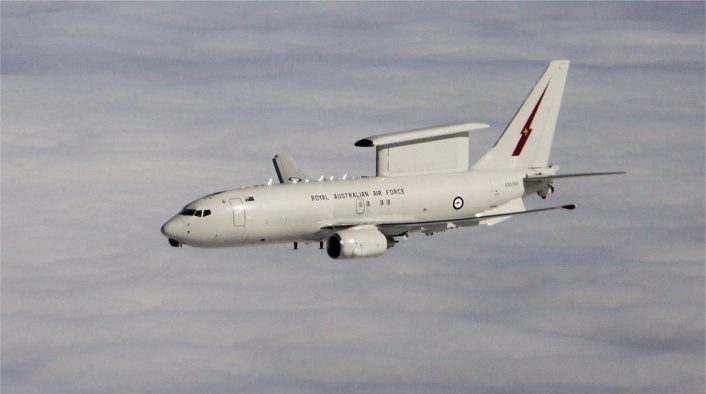
In July 2024 Defense News reported, when the Air Force and Boeing reached a deal for the E-7’s prototype, that the service initially evaluated the acquisition of a variant of the Royal Air Force’s Wedgetail. Requirements specific for the U.S. Air Force required more engineering work than anticipated, influencing the price and the negotiations.
The E-7A will provide advanced Airborne Moving Target Indication and Battle Management, Command and Control capabilities, and advanced Multi-Role Electronically Scanned Array radar that enhances airborne battle management and enables long-range kill chains with potential peer adversaries. The aircraft will have open systems architecture and agile software design enable the addition of new or improved capabilities on operational aircraft very quickly and at a reduced cost.

“Our customers have an urgent need for integrated battlespace awareness and battle management,” said Dan Gillian, vice president and general manager of Boeing Defense, Space & Security’s Mobility, Surveillance & Bombers division. “The E-7A is the airspace lynchpin to continuously scan the skies, command and control the battlespace, and integrate all-domain data providing a decisive advantage against threats. With our open systems architecture approach, capabilities can be rapidly inserted over time as threats evolve.”
In 2020 Boeing announced that works were in progress to upgrade the E-7 by integrating Open Mission Systems-compliant components. Specifically, Boeing integrated its Battle Management Command and Control (BMC2) system with an unspecified advanced wide-band Active Electronically Scanned Array (AESA) radar developed by Northrop Grumman.
Northrop Grumman is the developer of the Multi-role Electronically Scanned Array (MESA) radar located on a dorsal fin on top of the E-7’s fuselage. The radar provides 360-degree surveillance capability (although it doesn’t rotate like the E-3 Sentry’s antenna) with both air-to-air and air-to-surface coverage with and integrated Identification Friend or Foe system.
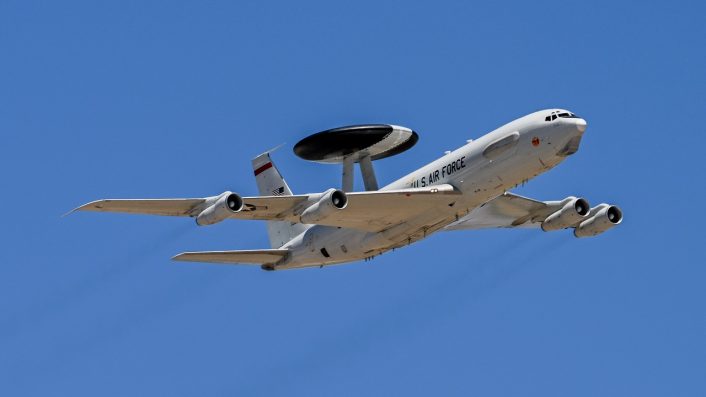
MESA provides the warfighter with critical domain awareness to detect and identify adversarial targets at long range and dynamically adjusts to emerging tactical situations, said the company. This will play a big part in allowing the E-7A to enable greater airborne battlespace awareness through its precise, real-time air picture and will be able to control and direct individual aircraft under a wide range of environmental and operational conditions.
The development work was anticipated to be completed by August 2024, according to the contract notice published in 2023. The USAF planned to begin production in fiscal 2025, with the first E-7A expected to be fielded by fiscal 2027, but it’s unclear if this timeline is still valid. The service anticipates procuring 24 additional E-7As by fiscal 2032, with a total projected aircraft inventory of 26 aircraft.