The first launch of the SM-6 is a ‘step-change’ in the lethality, air and missile defence, and long-range strike capabilities of Australia’s surface combatant fleet, as it undergoes a series of improvements to enhance deterrence and boost capabilities.
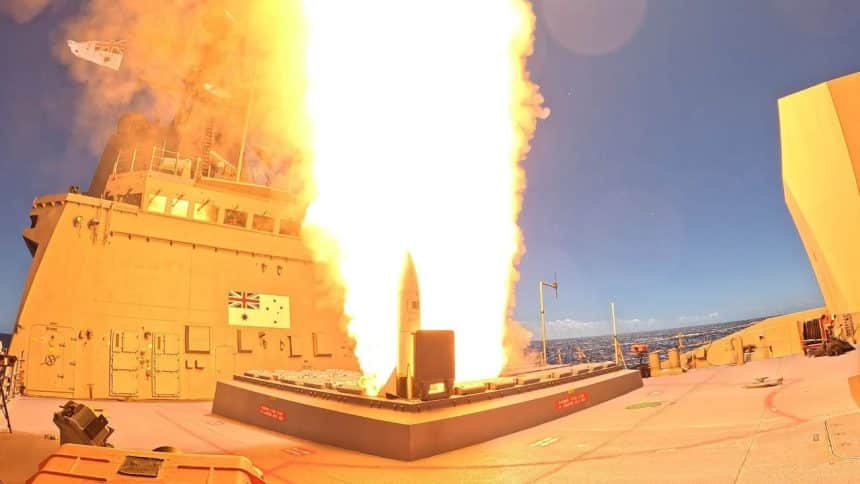
The Royal Australian Navy’s (RAN) HMAS Sydney guided missile destroyer test fired for the first time a U.S.-made SM-6 (Standard Missile-6) earlier this month, the country’s DoD (Department of Defence) revealed on Aug. 10, 2024. This first launch of the SM-6 marks the service’s acquisition of advanced and extended air defense capabilities, in line with the U.S. Navy, as part of the improvements being applied to the fleet.
“HMAS Sydney has conducted a successful firing of Standard Missile-6, only weeks after the successful firing of Naval Strike Missile,” Australia’s Department of Defence said. “This is another key milestone in enhancing the lethality capabilities of our Surface Fleet. Standard Missile-6 will further the Royal Australian Navy’s air defence capability, extend the range of the Navy’s weapon systems and complement Standard Missile-2 already in service.”
The test launch was performed in August as part of Exercise ‘Pacific Dragon’ 2024 near Hawaii, the DoD added, but the exact date of the event was not revealed. It added that the firing is a “step-change in the lethality, air and missile defence, and long-range strike capability of the navy’s surface combatant fleet.”
HMAS Sydney has conducted a successful firing of Standard Missile-6, only weeks after the successful firing of Naval Strike Missile. This is another key milestone in enhancing the lethality capabilities of our Surface Fleet. #YourADF <1/2> pic.twitter.com/o4TPUXtgWh
— Defence Australia (@DefenceAust) August 10, 2024
The SM-6’s firing also follows the first firing of the NSM (Naval Strike Missile) from the same warship during RIMPAC 2024 in July. Both weapons are part of the government’s efforts to enhance deterrence by rapidly boosting the Navy’s long-range strike capabilities and providing greater capacity to strike maritime, land and air targets at longer distances.
Another planned improvement is the addition of the Aegis Baseline 9 combat system which will provide the ability to counter airborne threats, including ballistic missiles. The Australian Defence Forces are also developing a Joint Air Battle Management System to connect the active missile defence systems, providing the foundation for further capabilities to be added over time.
The test
The video released by the DoD shows the SM-6 leaving one of the 48 Mk41 VLS (Vertical Launch System) cells in the HMS Sydney’s bow. It is not known if the missile hit a target, but the test was certainly meant to validate basic compatibility and functionality with the onboard radars and fire control systems.
It can be safely assumed that the RAN would conduct further complicated tests under various scenarios, possibly in exercises with the U.S. Navy. Meanwhile, HMAS Sydney will conduct a Regional Presence Deployment, before returning to Australia later this year.
“The Standard Missile 6 will be progressively deployed across the Navy’s Hobart-class destroyers and, in the future, the Hunter-class frigates,” the DoD said.“The addition of the Standard Missile 6 augments integrated air and missile defence-capable platforms.”
“Australia has three guided missile destroyers in service and will add the Aegis Baseline 9 combat system, which will provide the ability to counter airborne threats, including ballistic missiles,” mentioned the press release. HMAS Sydney, commissioned in 2020, is the third ship of the Hobart class, the other two being HMAS Hobart and HMAS Brisbane.
In the video, RAN chief Vice Admiral Mark Hammond said that the “extended range SM-6 complements the SM-2 weapon already in the RAN inventory.” He also added that “SM-6 enhances our fleet’s lethality providing a capability to strike aerial targets at extended ranges. (It) will be deployed on the Hobart-class destroyers and future surface combatants.”
Lt. Luke Olsen, an Air Missile Defence officer, explained in the video how the SM-6 fits into the larger scheme of AD roles. “My job is to recognize the air picture and understand everything that is happening within our scope of 250 miles (402 km) and ensure that the ship and the other assets under our command are protected at all times from air threats.”
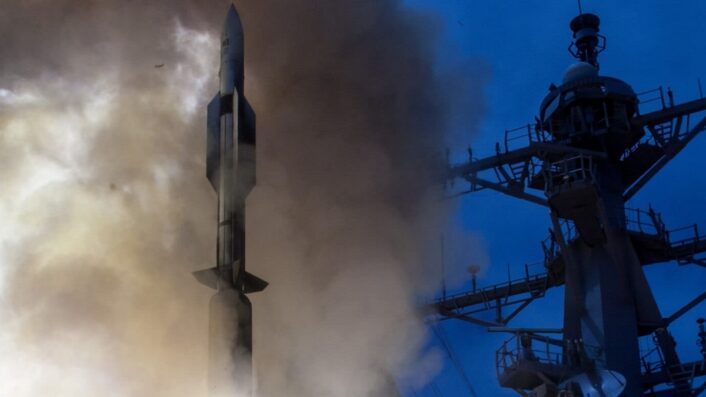
The Standard Missile 6
The RIM-174 Standard Extended Range Active Missile (ERAM), or Standard Missile 6 (SM-6), is a multi-mission missile capable of anti-air warfare, terminal ballistic missile defense, and anti-ship strike roles. The two-stage missile is first ejected vertically from the launch cell by an Mk 72 Solid Rocket Booster, after which a dual-thrust rocket motor takes over, allowing the missile to fly to ranges of 370 km.
An Active Radar Homing (ARH) seeker developed from the one of the AIM-120 AMRAAM (Advanced Medium Range Air-to-Air Missile) provides guidance to the SM-6 on its way to the target once it is out of the range of the ship’s radar. The missile uses a blast-fragmentation warhead, activated by radar and contact fuses, to engage targets in the endo-atmosphere.
US Navy littoral combat ship USS Savannah (LCS-28) conducts a live-fire demonstration on Oct. 24 in Eastern Pacific Ocean utilizing a containerized launching system that fired an SM-6 missile from the ship at a designated target.https://t.co/oJpYGdlTnw pic.twitter.com/tExSVSEk7C
— Ryan Chan 陳家翹 (@ryankakiuchan) October 25, 2023
It would be pertinent to note that the SM-6 is also a part of the U.S. Navy’s MRC (Mid-Range Capabilities) Typhon system, which also comprises the Tomahawk LACM (Land-Attack Cruise Missile). Here, the SM-6 is used for ship-strike roles thanks to the latent capability it possesses for surface-attack missions. The Navy also tested a containerized launching system on a Littoral Combat Ship.
Together with the LRHW (Long-Range Hypersonic Weapon) and the PrSM (Precision Strike Missile), the SM-6 is also part of the MRC Typhon the U.S. Army uses. Moreover, as The Aviationist had reported, the SM-6 was also spotted on U.S. Navy F/A-18 Super Hornets during RIMPAC 2024 in July, as an air-launched variant named AIM-174B.
The weapon has been officially employed in combat for the first time earlier this year, when the Department of Defense acknowledged that the USS Carney used the SM-6 to shoot down an anti-ship ballistic missile in the Gulf of Aden fired by Houthi rebels on Jan. 30, 2024. The SM-6 was also used in 2022 to hit the decommissioned frigate USS Boone during a SINKEX (Sink Exercise) which took place in the northern Atlantic Ocean, off Scotland’s northwest coast.
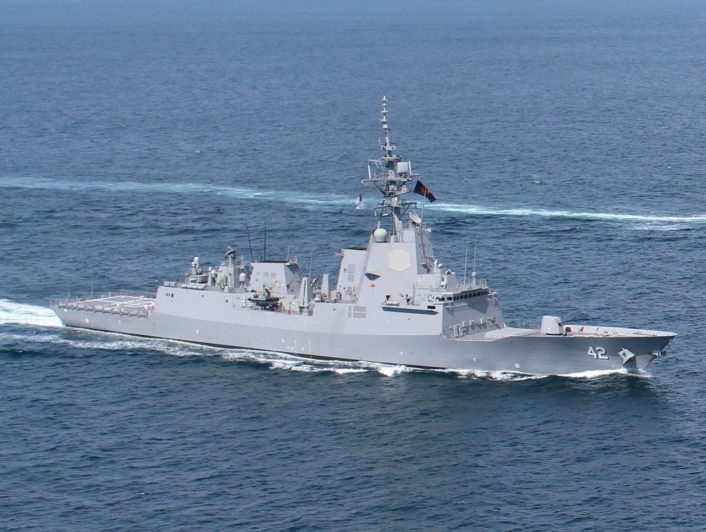
HMAS Sydney
Commissioned on May 18, 2020, HMAS Sydney is the last of three ships of the Hobart Class guided missile destroyers. Initially designed as Air Warfare Destroyers, these ships also have anti-surface, anti-submarine and naval gunfire support roles.
The Air Warfare Destroyer Alliance, from the former name of the Hobart class, constructed the ships in Australia. Like some of the American Arleigh Burke-class guided missile destroyers, the HMAS Sydney is equipped with the AN/SPY-1D phased array radar with an Aegis (Baseline 7.1) combat management system.
The Hobart Class carries a MH-60R helicopter for surveillance and response to support key warfare areas. The surface warfare function includes long-range anti-ship missiles, the Harpoon on HMAS Hobart and HMAS Brisbane and the NSM on HMAS Sydney, and a 5 inch naval gun capable of firing extended range munitions in support of land forces.
The Hobart Class also conducts undersea warfare and is equipped with modern sonar systems, decoys, MU90 Impact surface-launched torpedoes and an array of effective close-in defensive weapons, including a Phalanx CIWS (Close-In Weapon System). The three ships are also expected to become the first RAN warships to be equipped with the Tomahawk cruise missile, although the timeline is not known.