PD24 was the first exercise to use the IAMD-T, a semi-guided target designed to trigger and engage terminal ship defense combat systems, developed by the Naval Surface Warfare Center.
This year’s edition of the U.S. Navy and MDA’s (Missile Defense Agency) biennial Pacific Dragon 2024 exercise, which involves the testing of the SM-2 and 6 (Standard Missile-2, 6) anti-air interceptors, featured the debut of the new IAMD-T (Integrated Air and Missile Defense – Target). PD 24 was held with multiple Allied navies from Jul. 20 to Aug. 13 in the waters around the Hawaiian islands.
Developed by the NSW PHD (Naval Surface Warfare Center Port Hueneme Division), the existence of the IAMD-T was first reported by NAVSEA (Naval Sea Systems Command) in Sep. 2023. The system is described as a “semi-guided target designed to trigger and engage terminal ship defense combat systems, such as Standard Missile (SM)-2 and SM-6.”
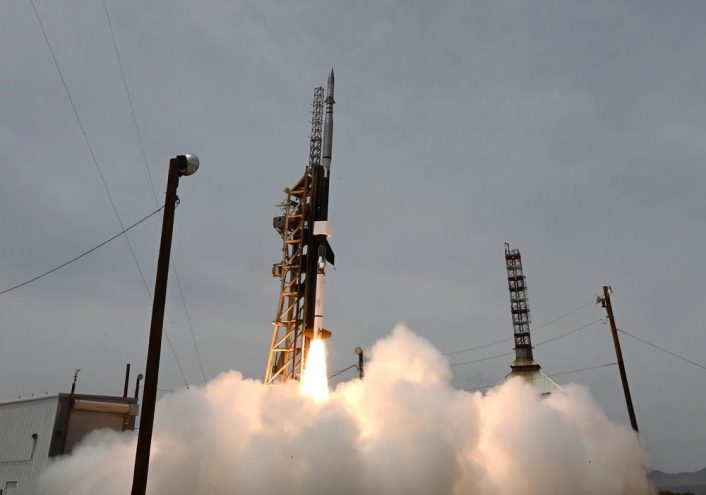
BMD (Ballistic Missile Defense) exercises testing the SMs often employ the ARAV (Aegis Readiness and Assessment Vehicle), whose ‘B’ variant (ARAV-B) was also fired as a part of PD 24 from the Pacific Missile Range Facility, Hawaii. The exercise later saw the launch of a SM-6 for the first time from HMAS Sydney earlier, as The Aviationist had reported.
The Aegis Readiness Assessment Vehicle Group B (ARAV-B) launches from Pacific Missile Range Facility, Hawaii during Pacific Dragon 2024, Aug. 7.
(📸/Pacific Missile Range Facility) pic.twitter.com/4C2WxOyEIG
— Guy Plopsky (@GuyPlopsky) August 17, 2024
The exercise
Hosted by the U.S. Navy’s 3rd Fleet, PD 24 is “designed to improve participating forces’ ability to work together to track and intercept ballistic missiles.” They conducted live-fire, simulated ballistic missile intercepts and tracking events to exercise, refine and improve their integrated air and missile defense (IAMD) capability in a coalition environment.
In addition to the United States, the participating nations include Australia, Italy, Japan, Republic of Korea and the Netherlands. The platforms include the HMAS Sydney from the RAN (Royal Australian Navy) and E-7A Wedgetail of the RAAF (Royal Australian Air Force); Italian Navy’s ITS Montecuccoli; JMSDF’s (Japan Maritime Self-Defense Force) JS Haguro, ROKS Yulgok Yi I; Dutch warship HNLMS Tromp; an MQ-9 from the 163rd Attack Wing of the California Air National Guard; and the U.S. Navy’s USS Carl M. Levin, USS Kidd, USS Shiloh, and P-8A Poseidon MPA aircraft.
The service added that “PD24 was the first to use a new and improved target called an Integrated Air and Missile Defense Target (IAMD-T).” The IAMD-T has been described as “a semi-guided target designed to trigger and engage terminal ship defense combat systems, such as Standard Missile (SM)-2 and SM-6.”
“Through exercises and engagements like Pacific Dragon, we improve system interoperability and tactical procedures with our allies and partners,” said 3rd Fleet commander Vice Adm. John Wade. “Combined operations and Integrated Air and Missile Defense tracking and live-fire events improve our proficiency.”
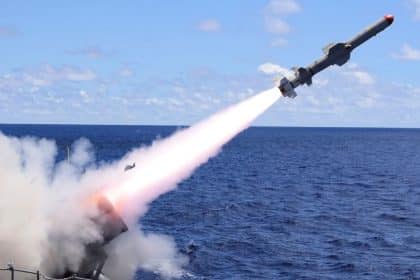
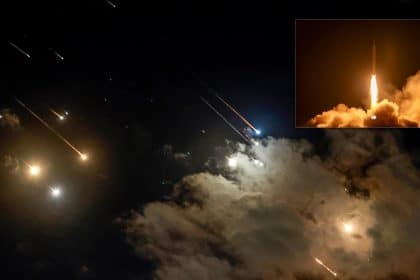
On Aug. 7, an ARAV-B was launched from the Hawaii facility, which was possibly engaged by a Standard Missile from one of the warships. ARAV is a solid-fuel rocket target which emulates ballistic missiles, helping to prepare the fleet to defend against those threats.
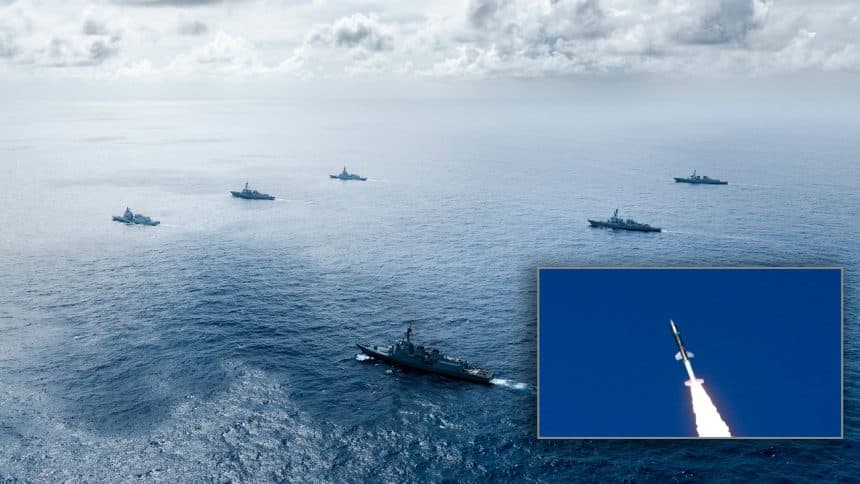
On Aug. 11, two days prior to the exercise’s conclusion, the warships of the participating countries sailed in formation, as shown by a photo released by the USN.
Aug. 10 — Royal Australian Navy destroyer HMAS Sydney conducted a successful first-of-class firing of a Standard Missile 6 during Exercise Pacific Dragon 2024 in vicinity of Hawaii.https://t.co/xBYiRAUKlh https://t.co/y8Jq3zb8MP pic.twitter.com/LlUY0TTuDF
— Ryan Chan 陳家翹 (@ryankakiuchan) August 10, 2024
IAMD-T
Last year, the NSWC’s White Sands Department said it performed two developmental flight tests for the IAMD-T, one during Pacific Dragon 2022 and the other during Exercise Formidable Shield in May 2023. On the same occasion, NAVSEA had already announced “a third IAMD-T test for the next Pacific Dragon in Aug. 2024.”
At the time it said that the target vehicle would carry a qualified flight termination system, allowing range control to disable the vehicle remotely. The goal of the test flight was “demonstrating the vehicle’s full guidance capability during all phases of flight, rather than just the final descent.”
The service has not released an image of the IAMD-T or details about the weapons used against it. On the other hand, as will be explained subsequently, the ARAV-B is likely to have been engaged by an SM-3, given public reports of the U.S’s BMD (Ballistic Missile Defense) testing regime, although the USN only explicitly mentioned SM-2 and SM-6.
ARAVs and Standard Missiles
The ARAV “emulates ballistic missiles, which helps prepare the fleet to defend against those threats,” according to NAVSEA. “ARAVs have tested the capabilities of multiple military combat systems, including the Navy’s Aegis Ballistic Missile Defense, the Army’s Terminal High Altitude Area Defense and the Patriot surface-to-air missile system.”
Three variants of ARAV are currently available, which differ in their range, on-board guidance and rocket motors to simulate short, medium and intermediate range ballistic missiles.
It appears that Kratos Defense manufactures the ARAVs, given their extensive description of the testing aids on their websites. Going by the company’s release from Nov. 27, 2023 and a CRS (Congressional Research Service) report from Aug. 6, 2024, the ARAVs have primarily been used during testing of the SM-3, specifically the SM-3 Block 1A variant, since Jun. 2006. ARAV variants simulating short, medium and intermediate range ballistic missiles were used in these tests.
The tests are called the Flight Test Aegis Weapon Systems (FTMs). The one in Nov. 2023 was FTM-48, also called Exercise Vigilant Wyvern, and resulted in a successful intercept of an SM-3 Block 1A against “two short-range targets.” The test “demonstrated the capability of a ballistic missile defense-configured Aegis ship to detect, track, engage and execute intercepts of two SRBM targets while concurrently demonstrating an Anti-Air Warfare (AAW) engagement of two subsonic anti-ship cruise missile drone targets.”