Raytheon Lands $1.19B Contract for AMRAAM Production Lot 38, Expanding Global Reach and Capabilities.
Raytheon is making the news these days: after receiving a $1B contract to upgrade the F-22 sensors and being fined 200M because its employees inadvertently divulged technical secrets and traded in aerospace components pertaining to nearly every major aircraft and missile system in its military with Russia, Iran and China, the company was awared a $1.19B contract by DoD on Sept. 11, 2024.
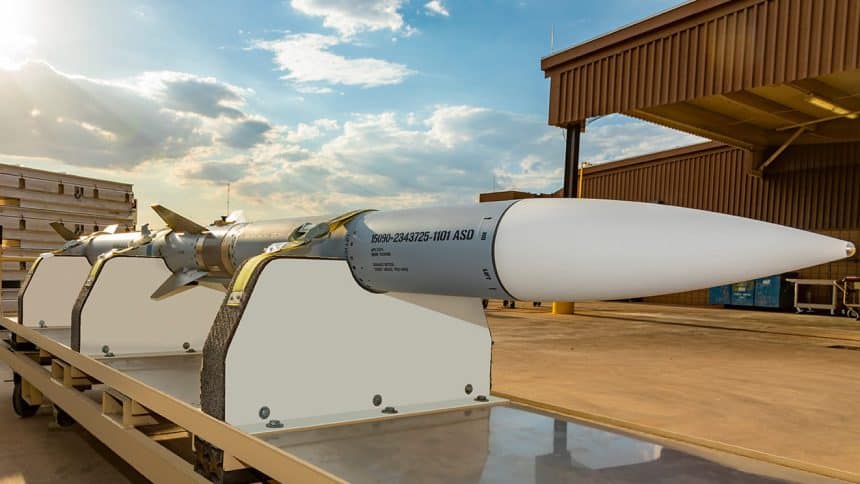
Raytheon Co., Tucson, Arizona, has been awarded a $1,195,985,081 firm-fixed-price, incentive modification (P00007) to a previously awarded contract (FA8675-23-C-0037) for Advanced Medium Range Air-to-Air Missile (AMRAAM) Production Lot 38.
This modification adds additional production of the AMRAAM missiles, AMRAAM telemetry system, initial and field spares, and other production engineering support hardware and activities.
Work will be performed in Tucson, Arizona, and is expected to be completed by Dec. 31, 2028.
This contract involves Foreign Military Sales to Bahrain, Bulgaria, Canada, Finland, Germany, Hungary, Italy, Japan, Norway, Switzerland, Ukraine, and United Kingdom. F
iscal 2024 missile procurement funds in the amount of $323,807,617; fiscal 2024 (Navy) weapons procurement funds in the amount of $262,102,997; fiscal 2024 (Navy) research and development funds in the amount of $2,067,754; fiscal 2024 (Air National Guard) operation and maintenance funds in the amount of $861,564; fiscal 2024 research and development funds in the amount of $344,626; fiscal 2024 operation and maintenance funds in the amount of $344,626; fiscal 2023 (Navy) weapons procurement funds in the amount of $260,804; and Foreign Military Sales funds in the amount of $602,921,149, are being obligated at the time of award.
Air Force Life Cycle Management Center, Air Dominance Division Contracting Office, Eglin Air Force Base, Florida, is the contracting activity.
“Air dominance is critical to staying ahead of increasingly advanced adversary threats,” said Paul Ferraro, president of Air & Space Defense Systems at Raytheon. “AMRAAM is the most advanced, combat-proven missile system, and this contract ensures we continue to provide our warfighters with the cutting-edge technology they need,” Paul Ferraro, president of Air & Space Defense Systems at Raytheon, said.
This latest contract is particularly interesting as it is the largest AMRAAM award to-date and comes 15 months after Raytheon received a $1.15B AMRAAM contract: as part of the Form, Fit, Function Refresh, also knowns as F3R program, RTX engineers have employed model-based systems engineering and digital technologies to upgrade several circuit cards and other hardware in the missile’s guidance section, as well as to re-host legacy software in the AIM-120D-3 and AIM-120C-8 variants of AMRAAM.
The contract, the sixth production lot of the highly advanced missiles developed under the F3R program, not only provides missiles to the U.S. Air Force and Navy but also includes AMRAAM all-up-rounds and spares for 18 other countries, including Ukraine and Japan, thereby extending the production line for both U.S. and Allied forces.
AMRAAM Capabilities and Production
As already explained in details, Raytheon’s AIM-120D3 AMRAAM, a variant of the Advanced Medium Range Air-to-Air Missile, is expected to complement the AIM-260 JATM (Joint Advanced Tactical Missile) as a high/low combination for U.S. fighters, according to Raytheon’s VP for Requirements and Capabilities, John Norman. While specific range capabilities were not disclosed, industry sources estimate the AIM-120D3’s range to be around 100 miles, with the AIM-260 capable of exceeding 120 miles.

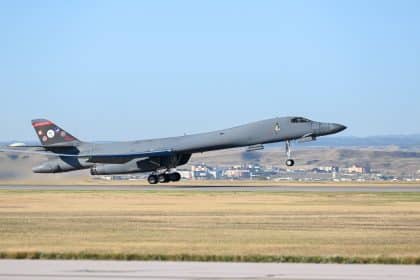
Raytheon recently secured a $1 billion contract to upgrade the F-22 fleet with advanced sensors, software, avionics, and communication systems. Prior to this, an F-22 was spotted with a rare configuration featuring external missile rails loaded with training variants of the AIM-120 AMRAAM at Edwards AFB.
Lockheed Martin’s AIM-260 JATM was developed in response to the long-range threats posed by Chinese and Russian BVR (Beyond Visual-Range) missiles, such as the PL-15 and R-37M/RVV-BD, which have ranges of at least 300 km. Raytheon’s Norman emphasized the importance of AMRAAM’s evolution, stating that its range now exceeds that of many threat missiles and will complement the AIM-260 JATM. “The range we can get with AMRAAM is approaching the threshold capability that the Air Force would like to have with JATM,” he said.
The AIM-120D3, developed using collaborative modeling and simulation with the Air Force, addresses modern threats with extended range and improved time of flight without altering propulsion. This enhancement enables the missile to retain more kinetic energy at long ranges, making it competitive against advanced threats worldwide. Additionally, the D3 variant features upgrades against digital radio frequency modulation (DRFM) jamming techniques and is compatible with 14 platforms across 43 countries.
Norman highlighted the missile’s enhanced performance during tests and its role as the affordable “capacity weapon,” contrasting with the AIM-260’s position as a premium, high-performance option. U.S. fighters are expected to carry both the AIM-120D3 and AIM-260 for a balanced approach to long-range engagements. This dual approach mirrors the high-low mix strategy used with older legacy platforms like the F-15, F-16, and F/A-18, which continue to play a role alongside advanced aircraft after receiving significant upgrades.
One of the key challenges for Raytheon is ensuring that pilots fully understand and utilize the AIM-120’s capabilities. This involves training at the Air Force weapons school, Air Warfare Center, and testing squadrons to refine tactics for the missile’s deployment.
In addition to air-to-air applications, the AMRAAM can be launched from the ground using the NASAMS (National Advanced Surface-to-Air Missile System). Several European countries have supplied their older AMRAAMs to Ukraine, achieving an effective rate of over 95% even with decades-old missiles.
Norman noted the increasing demand for AMRAAM production, with recent lots rising to 1,200 units annually from the historical 450-650 range. Raytheon is exploring international production options, with Japan as a potential partner, contingent on demand reaching 2,000 units per year to justify the investment in new production lines. “We need to see consistent demand so that there’s value in that investment,” Norman stated, highlighting the complexities of expanding production capacity.