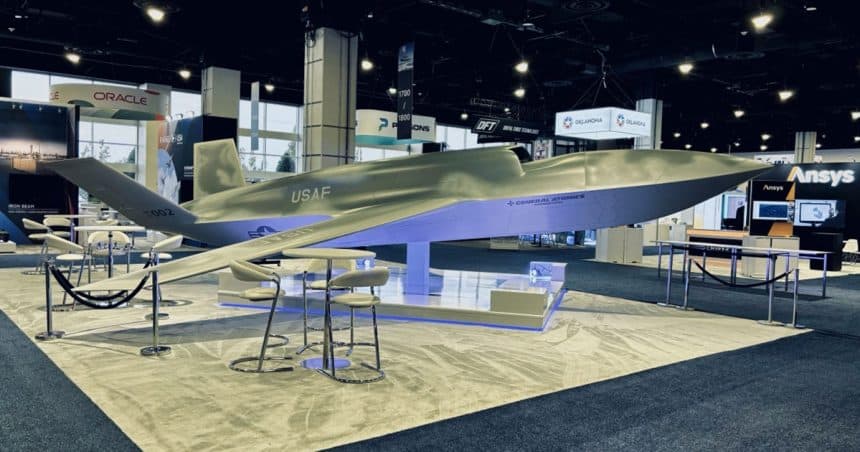
Full-scale models of the first increment’s CCA designs by Anduril and General Atomics are among the exhibits of this year’s Air, Space & Cyber Conference.
The Air Force Association’s (AFA) Air, Space & Cyber Conference 2024 has two new major displays of full-scale mockups of unmanned aircraft. In fact, this year’s edition of the conference features the designs by Anduril and General Atomics pitched for the Increment 1 of the Collaborative Combat Aircraft program.
Both companies already announced the exhibition of their models, Fury and the air-to-air variant of Gambit respectively, well before the conference. General Atomics also brought the XQ-67 Off-Board Sensing Station demonstrator which is currently undergoing flight testing, and upon which GA’s CCA is based.
Anduril and General Atomics are building their prototype CCAs, which are expected to fly in 2025. In 2026, the Air Force will decide which design will get to the production stage, although the service said that both might end up being produced.
Here’s the full scale model of the General Atomics collaborative combat aircraft prototype. #ASC24 #afanational pic.twitter.com/MnlzImOhbo
— Valerie Insinna (@ValerieInsinna) September 16, 2024
During the conference, Air Force Secretary Frank Kendall mentioned that the CCAs might not be tied to the Next Generation Air Dominance 6th gen fighter. Initially, the aircraft was defined as a “quarterback” able to control a number of CCAs in combat, with the service stating that the plan was to acquire 200 NGADs and 1,000 CCAs.
These comments follow the announcement of the pause in the NGAD’s development and its possible change of route to make the 6th gen fighter cheaper than an F-35 Lightning II. The latter was also expected to be able to work with CCAs. While the service initially envisioned a manned fighter controlling three-to-five CCAs, Kendall said the Air Force is “talking about bigger numbers than that now.”
An important aspect underscored by Kendall is that CCAs will be controlled only by manned aircraft, noting that the service doesn’t expect to move away from that combination anytime soon. This aspect is possibly linked to the ethical issues, which Kendall mentioned are being examined by the Air Force, associated with the employment of autonomous armed drones.
And here’s Anduril’s full scale model
Of its collaborative combat aircraft prototype here at #asc24 pic.twitter.com/wiiDAmxqr6
— Valerie Insinna (@ValerieInsinna) September 16, 2024
“One of the things you have to have if you’re going to use CCAs and have them be armed and lethal is that they have to be under tight control. And for me, one of the elements of that needs to be line-of-sight communications,” Kendall said. “We’re not going to have aircraft going out and doing engagements uncontrolled, so the default, if they lose communications, would be for them to return to base, which takes them out of the fight.”
The problem is not about imposing the rules on the autonomous systems, but rather about who needs to be accountable if those rules are not followed.
“Whatever weapon systems we employ have to be consistent with the laws of armed conflict. The problem isn’t that. We know what those rules are and I think we know how to impose them on our systems,” said Kendall said. “It’s who do you hold accountable. And I think we’ve got to think through. Is it the person who used the weapon? Is it the designer? Is it the tester? Is it somebody in the chain of command? I think there needs to be a discussion about the mechanism by which people are held responsible for whatever weapons do when they do something that’s not allowed.”
General Atomics has its actual Off-Board Sensing Station (OBSS) drone on the floor for the AFA conference. #asc24 pic.twitter.com/uoZAoyPCYl
— Valerie Insinna (@ValerieInsinna) September 16, 2024
This kind of ethical questions have always been to the forefront of the development of autonomous systems powered by Artificial Intelligence and Machine Learning. A way to deal with the problem is keeping always a human in the loop.
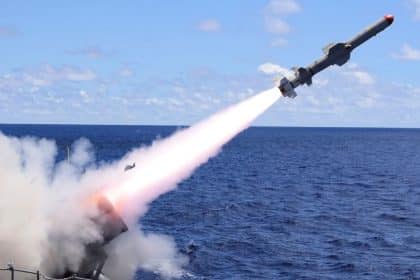
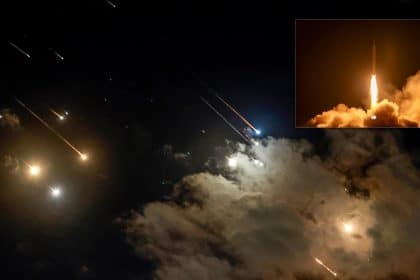
“Our policy is to have meaningful human control of the application of force, and we’re gonna keep that,” said Kendall. “But that leaves a lot of gray space in terms of how certain are you, what’s the degree of certainty you have that that’s a threat before you commit a weapon, and what degree of competency you want to have that you’re not going to impose collateral damage and kill civilians unnecessarily.”
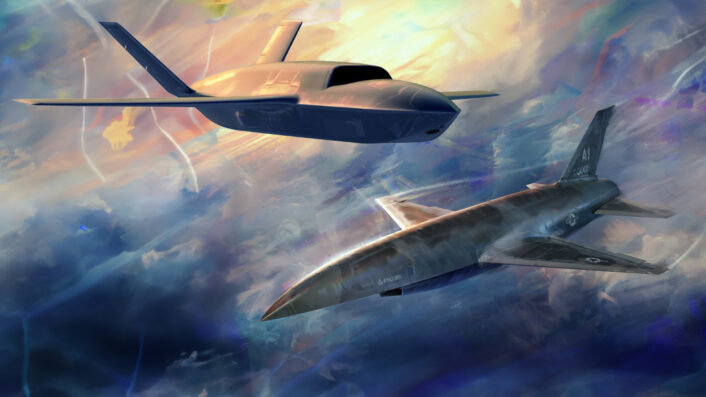
Collaborative Combat Aircraft Increment 1
The Department of the Air Force announced in April 2024 the decision to continue funding Anduril and General Atomics for the next phase of the Collaborative Combat Aircraft program. The work currently ongoing will lead to the final decision in 2026 for the first increment of CCAs, with the aim of deploying them by the end of the decade.
The two companies will now build production-representative CCA vehicles, and test-flight them, whereas Boeing, Lockheed Martin and Northrop Grumman, that also competed in the program, but were not selected, will continue to be part of the broader industry partner vendor pool consisting of more than 20 companies to compete for future efforts, including future production contracts.
The CCA program aims to develop autonomous unmanned aircraft that will cooperate in the “loyal wingman” role with fifth- and sixth-generation combat aircraft as part of manned-unmanned teaming concepts. The U.S. Air Force initially wanted to procure 200 NGAD fighters along with 1,000 CCA that will cooperate in the “loyal wingman” role with the sixth-generation combat aircraft.
The U.S. and its allies can take back the skies with a bold new program: the Collaborative Combat Aircraft.
Hundreds of new autonomous fighters are set to roll off American assembly lines and become the eyes, shields and swords of U.S. and allied pilots.
For 30 years, General… pic.twitter.com/HYTA3TwEcX
— GA-ASI (@GenAtomics_ASI) September 17, 2024
While each NGAD aircraft is expected to hundreds of millions of dollars, the CCA are designed to cost “in the order of a quarter or a third” of the current unit cost of an F-35. The anticipated CCA’s price is between $20.6 million and $27.5 million.
This value is less than the price of a MQ-9 Reaper, which costs roughly $32 million. Even if the cost is “small”, the CCA are not considered expendable or attritable, but rather “systems that you can accept losses of a fraction of them and not have a big operational impact”.
The Air Force is currently refining the specifications for the CCA program, particularly regarding the range and payload, to align with the operational needs of drones supporting crewed fighters. It’s established that CCAs will have a modular design, with some configured for weaponry and others for additional systems.
The first Increment of CCAs is focused on air-to-air combat, with manned aircraft designating targets for the CCAs armed with two AIM-120 AMRAAM (Advanced Medium Range Air-to-Air Missile) each.
The potential involvement of international partners, like Australia and Japan, in the Increment 2 is still possible as confirmed by the DAF statement, although details remain limited.
Increment 2 will introduce a new design, potentially a more advanced asset, with requirements distinct from the initial phase. While the focus for Increment 1 is swift production, subsequent increments will emphasize increased autonomy and expanded capabilities, according to Air Force Service Acquisition Executive Andrew Hunter.