The comments by Air Force Secretary Frank Kendall highlight a possible change of route from the 200 NGAD fighters expected to cost hundreds of millions.
The Next-Generation Air Dominance 6th generation fighter might drastically change to lower its unit cost below the one of the F-35, said U.S. Air Force Secretary Frank Kendall during the Air, Space & Cyber 2024 conference. The aircraft was initially expected to cost hundreds of millions apiece, with a total order of just 200 airframes.
These comments follow the statements in July 2024 when Kendall said the Air Force is reconsidering how it gains air superiority and would take a “pause” on the program. Kendall also added that the decisions about the future of NGAD must happen soon to be ready for the Air Force’s fiscal 2026 budget request.
“We are not walking away from the core United States Air Force function of providing air superiority,” Kendall said in a keynote address. During the address, the Secretary also linked together NGAD and the Next-Generation Air-refueling System (NGAS).
In fact, reducing the price tag of NGAD would possibly involve reducing range and payload of the aircraft, which would increase the reliance on tankers. Here then comes into play the capability to refuel the 6th gen fighter also in a contested airspace, with a tanker able to defend itself.
As for the price, Kendall said they “haven’t set a number or threshold.” “I’ll just give you this off the top of my head: The F-35 kind of represents, to me, the upper bounds of what we’d like to pay,” he later added.
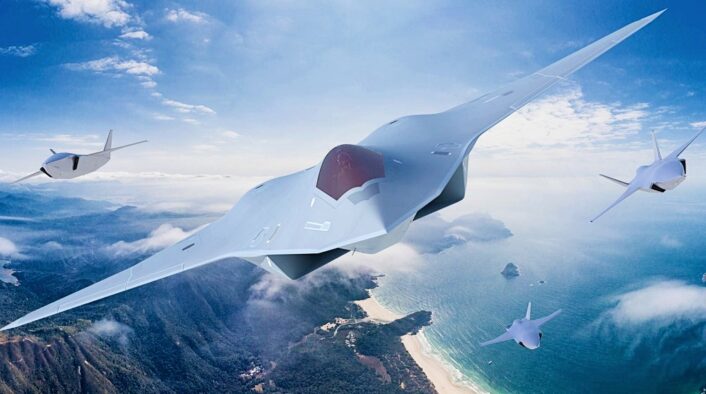
The comments about the “new” NGAD also follow the statements by U.S. Air Force chief General David Allvin during the UK’s Air and Space Power Association in London late in July 2024 about the service possibly moving away from NGAD. Allvin also revealed a notional “adaptable” concept of what has been defined as a “Light Fighter,” although it later emerged that the concept was AI-generated for the presentation.
Allvin advocated for switching from the paradigm of “built to last” of the Cold War and post-Cold War era to “built to adapt.” He said that the “underlying assumption” was that systems that were built to last would be “relevant” for the future, implying it might not be the case in many aerospace platforms today.
A “new” NGAD
A first step for reducing the price would involve a change in the design philosophy. Vice Chief of Staff James C. Slife noted that traditionally a new air superiority fighter was developed by “designing the characteristics around the platform; around the size of the radar you need, the range of the aircraft, how many Gs you wanted to pull. … You optimize for all of those things inside of a inside the platform.”
Slife however suggested a new approach, which would involve distribute capabilities among different assets. “We’ve gotten to a point where [with] our systems-level integration, we have the ability to disaggregate these capabilities and look at air superiority more broadly,” Slife said. “So the radar may be in one location, the munition may be in another location.”
One of the goals appears to be the mass, as the Air Force is looking to have a larger fleet of cheaper aircraft, rather than a small fleet of very expensive ones. “The more the airplane costs, the fewer you’re going to have. Numbers do matter,” noted Kendall.
According to the official comments, the Air Force will take advantage of the NGAD pause to go back to the origins of NGAD and reassess the requirements and how they can be met efficiently.
“From a requirements perspective, what I would say is we’re going back and starting at the beginning with ‘What is the thing we’re trying to do?’” Slife said. “‘How do we achieve air superiority in a contested environment?’ would be one way to frame the question. A different way to frame the question would be, ‘How do we build a sixth-gen manned fighter platform?’ I mean, those are not necessarily the same question.”
A possible cause could also be the advancements in the technologies, which can greatly influence the NGAD program initially started in the 2010s. Since “we did the initial analysis of alternatives for NGAD, frankly, our technology base has advanced in ways faster than we anticipated,” said Andrew Hunter, Assistant Secretary of the Air Force for Acquisition, Technology, and Logistics. “So we see that there are capabilities that we have [now] that perhaps we would want to be part of this mission space going forward that weren’t baked into where we started with the NGAD system.”
Kendall highlighted that the Air Force have to move quickly with the assessment and the decisions. The reason for this, he mentioned, is due to expectations from Congress and industry (a contract was expected by the end of the year) as well as the need to submit the 2026 budget request.
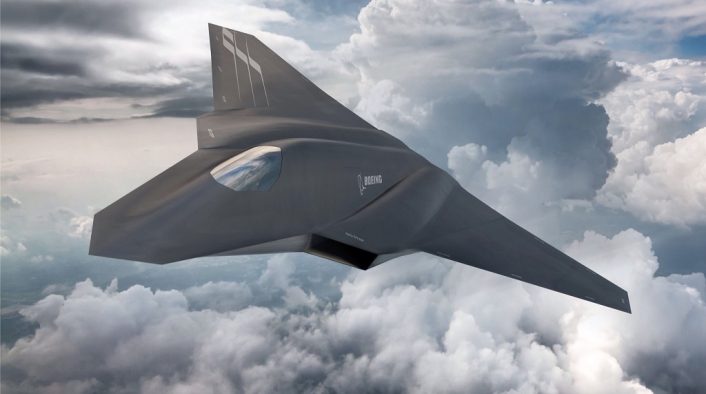
The “old” NGAD
In September 2020, Dr. Will Roper, the then Assistant Secretary of the Air Force for Acquisition, Technology and Logistics, made it public that the U.S. Air Force had secretly designed, built and flown at least one full-scale prototype of a new generation fighter aircraft, as part of the Next Generation Air Dominance (NGAD) program.
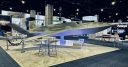
Few days after the digitally-engineered advanced sixth-generation full-scale flight demonstrator was announced, the Secretary of the Air Force Public Affairs published on the Defense Visual Information Distribution Service an interesting graphic for the Air Force’s 73rd birthday featuring an unknown new aircraft.
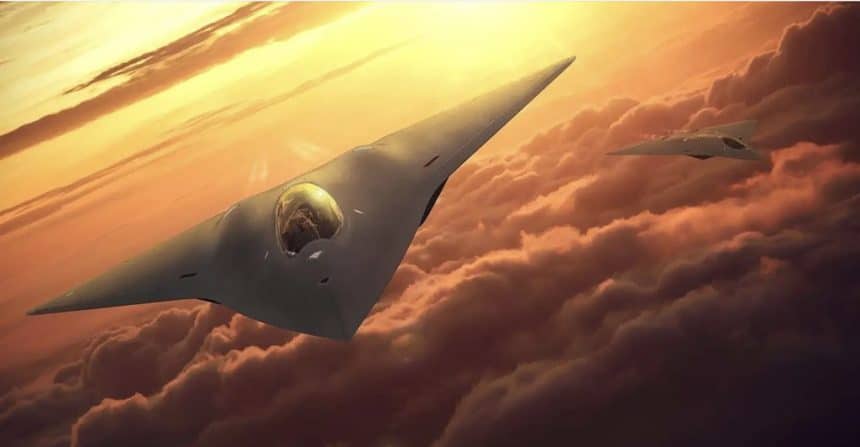
While the aircraft in the image could be completely fictional, its shape could also be a loose hint at the design chosen for the first prototype build for the Next Generation Air Dominance (NGAD) program.
Fast forward to 2023, according a podcast from the Defense & Aerospace Report, which you can find here, at least three NGAD demonstrators are involved in testing. A couple of weeks later, on Jul. 1, 2023, Lockheed Martin’s official Instagram account posted an story to celebrate the 80th anniversary of its famous Skunk Works advanced projects division. Among the aircraft silhouettes shown in the IG story, there was one that really struck everyone’s attention: the one of an unknown, clearly manned next generation aircraft.
Later that year, Air Force Secretary Frank Kendall revealed that a secret, multi-agency X-plane program paved the way for NGAD by demonstrating new technologies for the 6th gen aircraft and its family of systems. The program was part of “The Dominance Initiative” study commissioned to DARPA (Defense Advanced Research Projects Agency) in 2014.
It is not clear if Kendall refers to the same full-scale flight demonstrator mentioned by Roper in 2020 or if these prototypes explored new advanced technologies that later merged in that demonstrator. The latter explanation appears to be the most likely, as the Secretary added NGAD is currently structured as “the combination of aircraft – a crewed aircraft [and] unmanned aircraft – that will have some of those technical characteristics we demonstrated could be done”.
Before the latest news and the pause on the program, the U.S. Air Force wanted to procure 200 NGAD fighters along with 1,000 CCA that will cooperate in the “loyal wingman” role with the sixth-generation combat aircraft. While each NGAD aircraft is expected to hundreds of millions of dollars, the CCA are designed to cost “in the order of a quarter or a third” of the current unit cost of an F-35.
Considering the average unit price for F-35s in the latest production lots is around $82.5 million, the CCA’s price could be between $20.6 million and $27.5 million. This is less than the price of a MQ-9 Reaper, which costs roughly $32 million. Even if the cost is “small”, the CCA are not considered expendable or attritable, but rather “systems that you can accept losses of a fraction of them and not have a big operational impact”.