The Low Cost Attritable Aircraft Platform Sharing program exploits the biology’s “genus” and “species” concept, which will allow the use of a common base system to build large numbers of inexpensive, tailored-role uncrewed systems for affordable but credible mass.
The AFRL (Air Force Research Laboratory) has released a new concept video of its LCAAPS (Low Cost Attritable Aircraft Platform Sharing) program, showing an autonomous “mother” drone and its collaborative unmanned aircraft undertaking air-to-air missions. The AFRL calls these systems Autonomous Collaborative Platforms (ACL).
The video shows five drones, comprising a main commanding UCAV flanked by two collaborative autonomous drones on either side, tackling together an hostile air target. Obviously, the systems are modular and open system architecture-enabled for ‘scalability’ and ‘low cost’ that are the mantra in today’s weapons design doctrines.
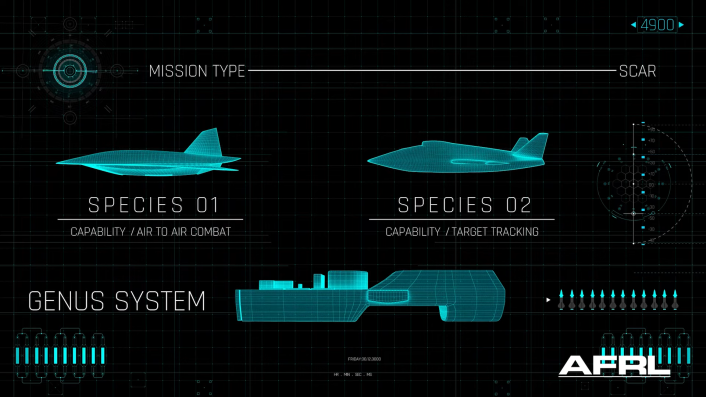
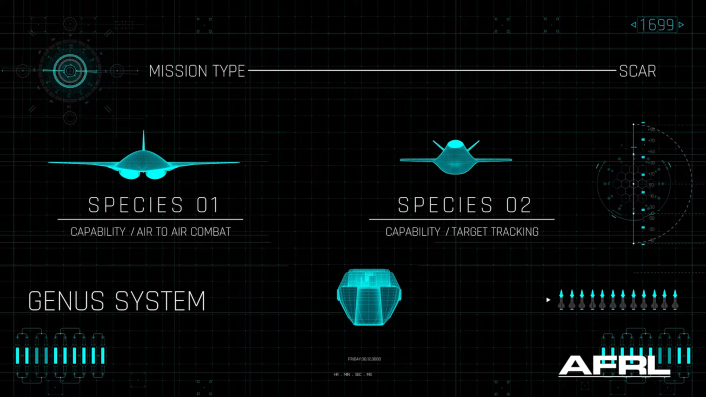
However, the leading feature here is the “genus” and “species” concept borrowed from biology, where both the primary UCAV and its collaborative drones, although they are different airframes with different design configurations, are built upon a common base system.
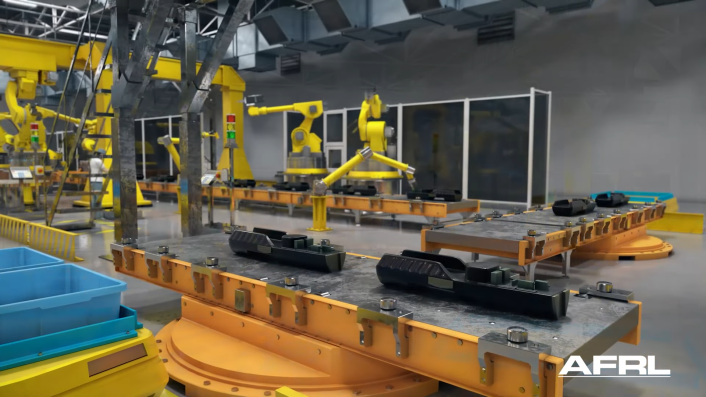
The latest AFRL rendition, possibly the first covering the LCAAPS, shows the automated manufacturing effort “inspired by the automotive industry’s best design and manufacturing practices,” with automated factory lines where robotic arms assemble the drones on conveyor belts.
AFRL video
In the video, the main drone is shown firing an externally-carried air-to-air missile (AAM) that hits a target. The double delta wing UCAV is carrying external payloads on wing hardpoints, indicating that stealth might not be a priority in this program. Having a stealth UCAV with these complicated engineering features increases production cost and is not quickly scalable, killing the fundamentals of the LCAAPS.
The LCAAPS UCAVs in the AFRL video are also portrayed connected in a network, allowing coordinated formation flight and trading sensor data among the platform. The drones’ design configurations are also peculiar. The main UCAV, called “Species 1” and with its main capability being air-to-air combat, is a twin-engine design with two underbelly intakes and a standard vertical stabilizer. The “Species 2” collaborative drones are single-engine designs with a canted V-tail and a top fuselage-mounted air intake.
It must be noted that the designs of the LCAAPS’s autonomous combat and sensor support drones shown in the video might be only notional and thus might not necessarily find their way into the final production configuration.
‘Genus/Core’
The common fundamental base, around which the different airframes are built, conveys commonality of parts and components. This uncomplicates and eases supply chains as more components of the same make could be ordered, gaining economies of scale and effecting the “low” in the Low-Cost Attritable Aircraft Platform Sharing. Maintenance and upgrades become easy both because of the modular, open systems and interchangeability of the parts.
The ‘genus/core’ concept augments the Air Force with high-end platforms with “large numbers of inexpensive, tailored-role uncrewed systems, providing affordable but credible mass,” says the AFRL. The mass is becoming a focus in many programs, including the Next Generation Air Dominance which might be restructured to have larger numbers of 6th generation fighters at lower costs.
This new approach to weapons system acquisition, allows to “provide U.S. forces with large numbers of rapidly developed, low-cost, autonomous, collaborative platforms, achieving larger numbers by streamlining the design and development process,” said the video. This is opposed to previous “unique capabilities” which were developed independently, with higher costs and longer production timelines.
The “core structure” is a “set of flight critical subsystems” (or “genus” platform) “that can be shared and used as the foundation for various autonomous collaborative platforms (or “species”), each with unique capabilities,” explains the AFRL. The genus, beside “faster and cheaper production,” can flexibly incorporate new technologies, upgrades and field them quickly.
GA-ASI’s XQ-67A and Gambit
This rendition comes six months after the General Atomics’ XQ-67A OBSS (Off-Board Sensing Station) flew for the first time on Feb. 28, 2024 from the company’s Gray Buttle Flight Operations Facility near Palmdale, California. AFRL mentions that the XQ-67 already proved the feasibility of this approach.


The OBSS is an off-shoot of the LCAAT (Low Cost Attritable Aircraft Technologies), within the broader LCAAPS. The XQ-67 leveraged the work done by General Atomics on its Gambit family of drones, which follows the “genus and species” concept with a common core and modular systems installed on it.
The AFRL also said in the video that the XQ-67A “demonstrates how wholly new acquisition processes can deliver capability to the warfighter more quickly and efficiently.” So far, the OBSS remains shrouded in mystery but Breaking Defense reveals it to be demonstrating an unmanned aircraft, with a significant degree of autonomy and sophisticated sensor arrays, which can fly “beyond the line-of-sight” of 4th, 4.5 and 5th generation aircraft and beam back targeting and other data. These could be either from optical or electromagnetic sensors.
That report from Feb. 2023 said that the AFRL was nearing testing of the GA-ASI’s Gambit drone, and was projecting its first flight in the first half of this year. The company said in a press release that the Gambit series of aircraft “validate” the AFRL’s “genus/species” as “part of the LCAAPS,” that focused on “building aircraft variants from a common core chassis.”
Coming back to the XQ-67A, while being modular with open systems architecture for easy upgradability, it also incorporates the “genus” and “species” concept of the “common chassis,” paving the way for “other aircraft ‘species’ to be rapidly replicated on a standard genus chassis.”
In fact, the LCAAPS was described as the major effort that initially explored the genus/species concept and fed the technology and knowledge forward into the OBSS program that culminated with building and flying the XQ-67A.
Conclusion
The video also hints how LCAAPS might tie into DARPA’s (Defense Advanced Research Project Agency) AIR (Artificial Intelligence Reinforcements) program, for which it recently awarded BAE Systems’ FAST Labs a $4 million contract for the Phase 1. That requires the company developing AI (Artificial Intelligence) and ML (Machine Learning) systems for autonomous BVR (Beyond Visual Range) combat. The company is expected to develop and test the systems on F-16 test beds (possibly the VENOM program or the X-62A Vista), before transferring the technology to UCAVs.
The future of air superiority can’t wait.
That’s why we are working with Air Force Research Laboratory to build #XQ67A today.
Learn more: https://t.co/uAqv5ViFno pic.twitter.com/oFfFwwRpqo
— GA-ASI (@GenAtomics_ASI) August 19, 2024
Whether the LCAAPS-influenced XQ-67A has a future relationship with DARPA’s AIR or the X-62A Vista is uncertain, but that possibility cannot be discarded either. The AFRL itself has used DARPA’s “AI agents” to successfully pilot the X-62A 12 times in Dec. 2022. They performed one-on-one BVR (Beyond Visual-Range) combat and WVR (Within Visual Range) “dogfighting,” executing autonomous tactical maneuvering while maintaining real-world airspace boundaries and optimizing aircraft performance.