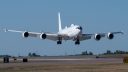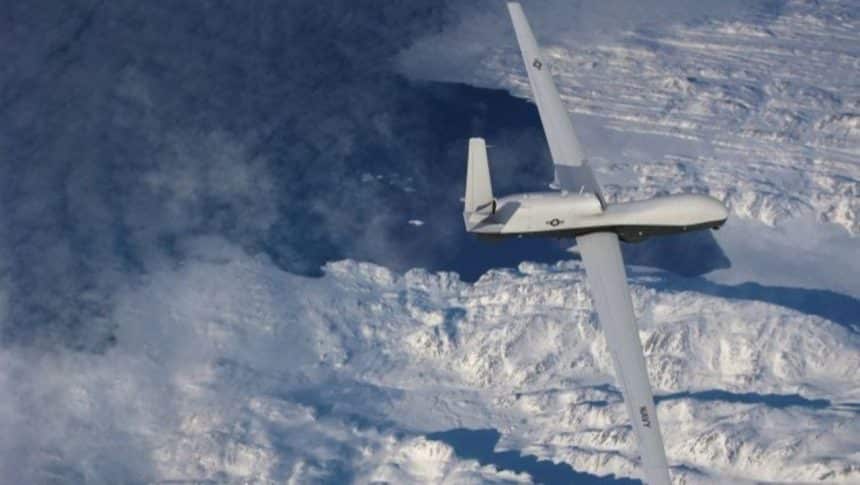
The ‘test flight’ validated the drone’s critical intelligence, surveillance, reconnaissance and targeting capabilities in the High North’s harsh, austere and frigid environment.
Northrop Grumman’s MQ-4C Triton High-Altitude Long-Endurance (HALE) surveillance and intelligence UAV “successfully demonstrated” its “navigation system’s ability to operate at high latitudes deep within the Arctic Circle,” the company said in a release on Sep. 19, 2024.
The test flight began in Deadhorse, Alaska, and saw the drone flying within 100 miles of the North Pole in a five-hour flight, utilizing Northrop’s “proprietary navigation systems, mission management computer and upgraded operational flight programs to successfully demonstrate Triton’s ability to navigate in the Arctic.”
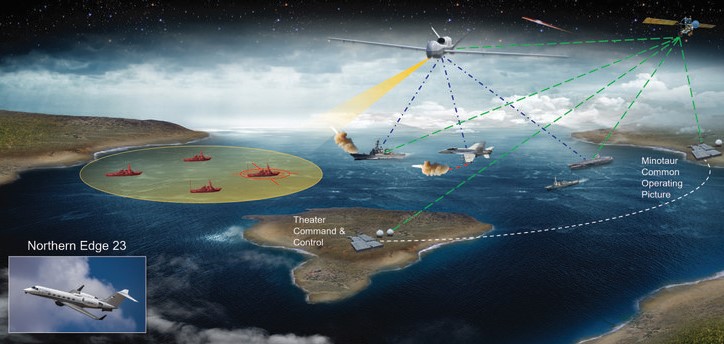
The flight test follows a similar demonstration conducted over the Gulf of Alaska in June 2023, during the Northern Edge 2023 exercise. At the time, an MQ-4C Flying Test Bed (FTB) demonstrated its radar’s “unmatched ability to detect, track and image targets with weapon relevant accuracy and at a survivable range over a high-sea state environment.” The company has described the Triton’s strategic role “to enhance joint, distributed maritime operations, and further support sea-control in contested environments.” At the time, the Triton was preparing for its Initial Operational Capability (IOC).
We successfully demonstrated the #MQ4C Triton navigation system’s ability to operate at high latitudes deep within the Arctic Circle and proving #ISRT capabilities in the High North. As a high-altitude, long-endurance platform, Triton is suited for missions in the High North by… pic.twitter.com/0t4GHHQm9h
— Northrop Grumman (@NGCNews) September 19, 2024
The latest “test flight” validated the drone’s “critical intelligence, surveillance, reconnaissance and targeting capabilities in the High North’s harsh austere environment over the Arctic Ocean.” Triton’s advanced technological design makes it the only autonomous high-altitude, long-endurance aircraft capable of operating at altitudes above 50,000 feet for durations of more than 24 hours.
Triton’s increasing importance
The Triton is also meant for Intelligence-Surveillance-Reconnaissance (ISR) roles over the Indo-Pacific region, given how the Royal Australian Air Force (RAAF) received the first of its four planned aircraft at its RAAF Base Tindal on Jun. 16. The drone with serial number ‘A57-001’ landed at the base in dark hours and was moved into the hangar. As for the European theater, the U.S. Navy in April announced the arrival of the first MQ-4C Triton for the Unmanned Patrol Squadron 19 (VUP 19) at Naval Air Station Sigonella in Italy.
The Triton supports a “wide range” of missions, including “maritime patrol, signals intelligence and search and rescue.” The MQ-4C Triton operates at a higher altitude and has a longer endurance than medium-altitude systems. It also incorporates simultaneous multi-intelligence sensor operations that allows it to deliver an exponential increase in mission information. It means the aircraft can exchange data with other Allied sea, air, land and space-based assets for optimal strategic situational awareness with its over 24 hour endurance.
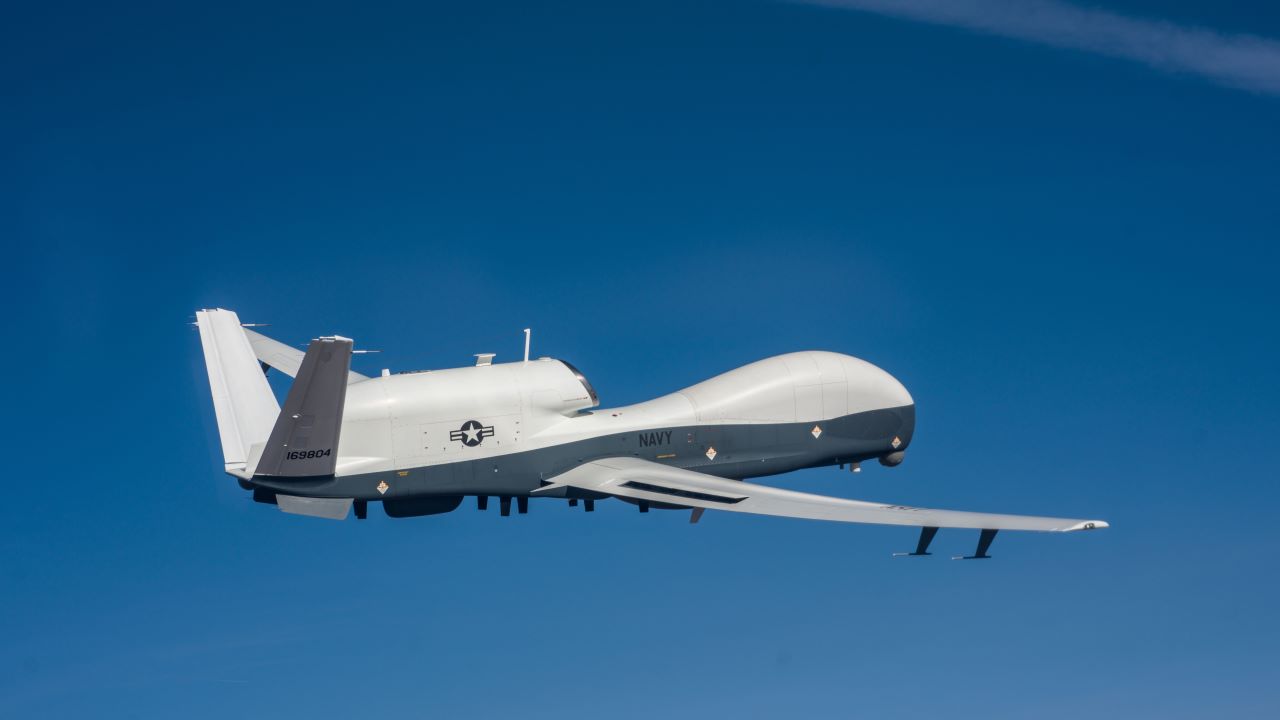
The test flight comes amid the geopolitical backdrop of Russia’s resumption of exploring the Arctic with nuclear-powered icebreakers; Sweden and Finland’s accession to NATO; as well as Russian and Chinese Tu-95 and H-6 strategic bomber flights in “international airspace” off Alaska’s coast in August. In other words, that region an overlap of the European, Arctic and Indo-Pacific theaters, putting the importance of platforms like the Triton in perspective.
Latest Arctic flight
Northrop said that the “test aircraft collected navigation data during the five-hour flight and remained within U.S. and Canadian airspace for the duration.” The demonstration also validated ground-based GPS alignment and initialization procedures to enable operations from runways above 70 degrees north latitude. As a HALE-class platform, Triton can fly “above” the High North’s “Arctic winds” at 50,000 feet and avoid “impacts” on the “range and speed” they impose at “medium altitudes,” of “10,000-30,000 feet.”
Its defining “de-icing” and “anti-icing” features aid this capability. The test flight in “challenging environment” and “extreme Arctic conditions” is vital for exhibiting the Triton’s kinematic, avionics and sensor performance “as allies consider their options for acquiring uncrewed maritime surveillance aircraft.”
Jane Bishop, vice president and general manager, global surveillance division, Northrop Grumman said that flight operations in “austere and frigid conditions present unique navigation challenges.” “Our demonstration highlights Triton’s ability to successfully perform in that challenging environment.”
Capt. Josh Guerre, Triton program manager, U.S. Navy said:“Arctic regions are an increasingly important theater of operations with unique threats and environments. We are ready to support those mission sets for domestic and international customers.”
Exercise Northern Edge 2023
As mentioned earlier, the Triton Flying Test Bed (FTB) was put through a similar test flight during June 2023’s Northern Edge exercise. At the time, the Triton was flown to perform “critical long-range targeting capabilities” for “joint forces” to “effectively operate and respond to contingencies in the Pacific or anywhere in the world.”
A KC-130J Super Hercules with @1stmaw_marines conducts an aerial refueling with a @usnavy EA-18G Growler during Exercise Northern Edge 23-2 over Japan, July 17.#NorthernEdge 23-2 is a joint field training exercise at various locations in the Pacific region from July 2-21, 2023. pic.twitter.com/kDOL6rwzS3
— U.S. Marines (@USMC) July 19, 2023
The Triton FTB exercise scenarios, executed during multiple flights over seven days, focused on tasking, collection, processing, exploitation and dissemination of information to help maintain a robust common operating picture. During the exercise, the Triton FTB tracked and monitored all maritime traffic within its broad visual field.
Upon receipt of the data, ground operators at Joint Base Elmendorf-Richardson near Anchorage were able to process and disseminate the Gulf of Alaska maritime common operating picture to command and control units using Triton’s Minotaur mission interface. Executed in collaboration with the U.S. Navy’s Persistent Maritime Unmanned Aircraft Systems Programs Office (PMA-262), the exercise showcased the Triton’s developing technologies such as Artificial Intelligence (AI) and Machine Learning (ML).