The Japan MoD said that aircraft like the EP-3, the EW variant of the P-3C Orion, itself being replaced by the P-1 where it uses both the U.S.-origin planes, do ‘not meet the functions and performance requirements of the JMSDF’, and would also be ‘difficult to maintain’ in the mid-2020s’. Meanwhile overseas airborne EW planes and technology are ‘difficult to acquire’.
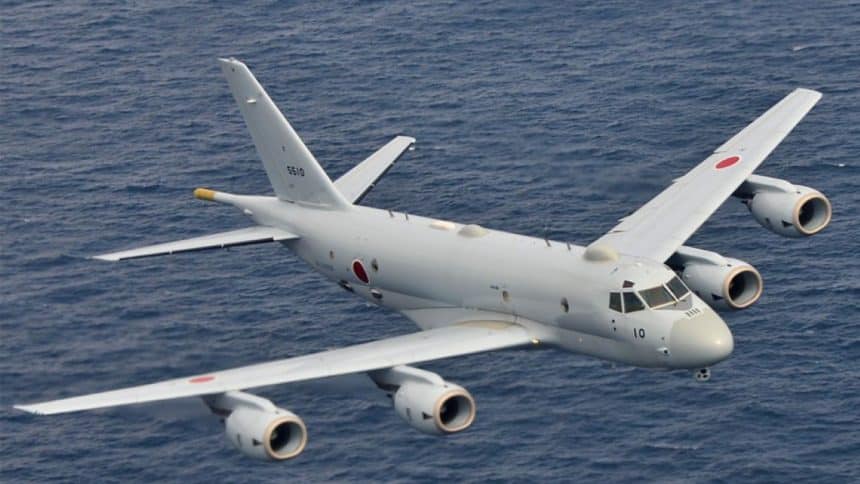
Japan is advancing its own domestic Electronic Warfare (EW) plane, based on its indigenously-developed Kawasaki P-1 Maritime Patrol Aircraft (MPA). Its Ministry of Defence (MoD) has sought $292 million for Fiscal Year 2025 to acquire an EW plane for the Japan Maritime Self-Defense Force (JMSDF). The country has seen persisting military threats from Russia, North Korea and China.
Reports quoting the Japan MoD budget document said that Tokyo aims to strengthen “capabilities to gather information on electromagnetic waves” which is “necessary for electronic jamming and electronic protection.” The war in Ukraine has shown the significant impacts of Russian EW, which has had a devastating impact on Ukrainian battlefield communications and drone operations.
The PLA Air Force’s Y-9LG electronic attack and EW plane that made an appearance during Chinese military drills with Thailand in August, has been assessed to be a long-range jamming platform by The War Zone. The U.S. Air Force’s Air Combat Command welcomed its first EA-7B Compass Call at the Davis-Monthan AFB on Aug. 23, 2024.
/
📢#1枚でわかる防衛省・自衛隊 !
\
第42回目は「電磁波領域の動向について」の第二弾です☝
防衛省では電磁波領域の優勢を確保するため、相手方のレーダー利用や通信を無効化する能力を有する装備品を整備するなど、電子戦能力の強化に取り組んでいます。#電磁波 #電子戦 https://t.co/cTSWv1Vn2c pic.twitter.com/mCbSrbNcZb
— 防衛省・自衛隊 (@ModJapan_jp) March 28, 2024
‘Need homemade electronic warfare systems and aircraft’
The Japan MoD document, noting that there are “multi-purpose aircraft (EP-3, etc.),” adds “none that meet the functions and performance requirements of the JMSDF.” Additionally, “it will become difficult to maintain these multi-purpose aircraft in the mid-2020s.” “Similar equipment and electronic warfare aircraft from overseas are difficult to acquire due to their defense sensitivity.”
The EP-3 is the Communications, Signals and Electronic Intelligence (COMINT, SIGINT and ELINT) version of the P-3C Orion Maritime Patrol Aircraft. Japan operates both the EP-3 and the P-3.
The P-1 plane meanwhile first flew in September 2007 and the JMSDF received the first two units on Mar. 27, 2013.
Japan aims to replace about 80 of its aging P-3C Orion MPAs with about 70 P-1 aircraft, according to The Japan Times.


Given that the P-1 MPA is meant to replace the P-3C Orion, it can stand to reason that the new P-1 based EW plane is also being evolved as a substitute for the EP-3. This is especially at a time of increasing North Korean cruise and ballistic missile launches, which require persistent monitoring on Pyongyang’s radar, communications emissions and the missiles’ telemetry data being beamed back to the ground control centers. It must be clarified that this particular document in question does not specifically mention either China, Russia or North Korea. Thus the Japan MoD “aims to reduce development costs by utilizing the results of previous research into next generation electronic intelligence gathering aircraft.”
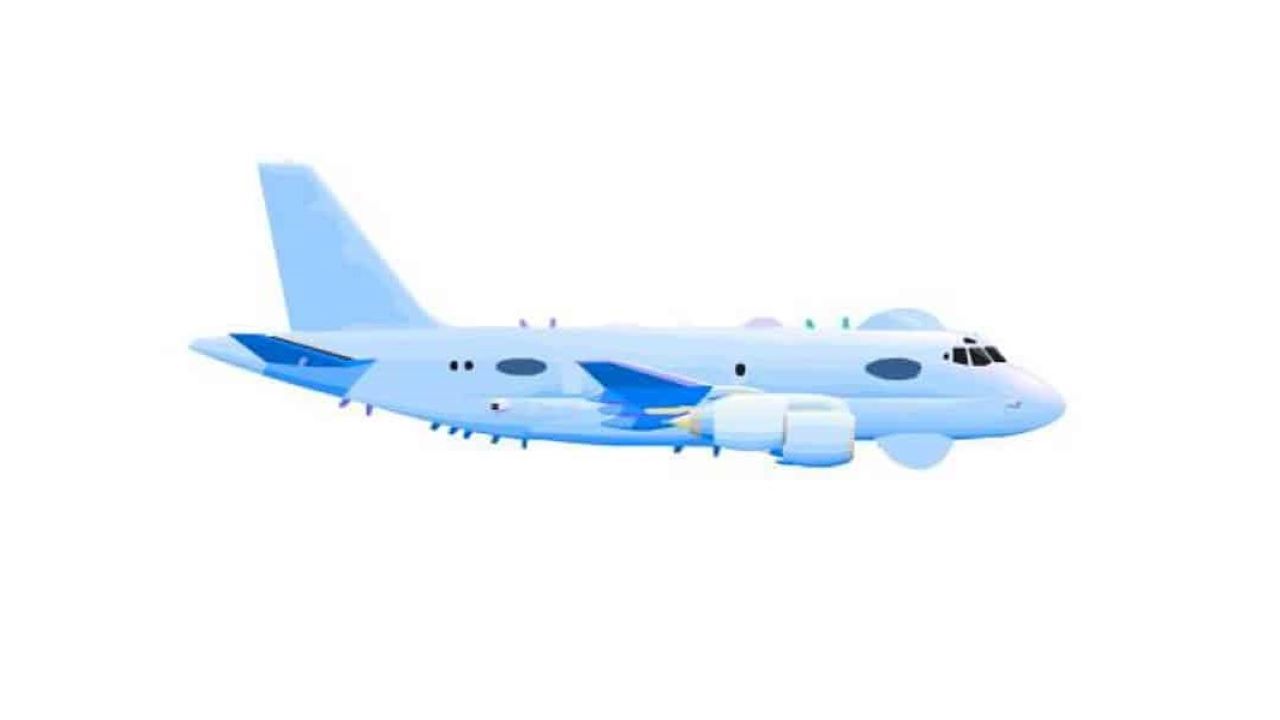
An “electronic warfare aircraft will be developed based on the P-1 by the required time, incorporating the electronic intelligence gathering capabilities of utility aircraft that are expected to be decommissioned around the 2020s, and contributing to strengthening the electromagnetic domain capabilities necessary for cross-domain operations.”
The image of the planned EW-capable P-1 shared by the Japan MoD on X, showed the aircraft with hemispherical bump-shaped radomes under the chin, on the top fuselage, spine and multiple blade-shaped antennae on the underbelly and the top and bottom tail line.
Capable aircraft with all-Japanese systems
The P-1 has the distinction of being purpose-designed as a MPA (Maritime Patrol Aircraft), and not converted for the role like Boeing P-8 Poseidon used by the U.S., Indian Navy or Royal Australian Navy. The P-8 is derived from the Boeing 737-800 airliner. The P-1 also flies with an indigenous IHI Corporation F7-10 turbofan in a four-engine configuration installed on low-set wings, with the powerplant too specifically developed for the P-1.
The Full Authority Digital Engine Control (FADEC)-enabled F7s have a high bypass ratio of 8:1, according to Japanese reports, and enable a cruising speed of 830 km/h and a maximum speed of 996 km/h. This makes it 1.3 times faster than the P-3C Orion, can operate at higher altitudes and has surveillance endurance of 10 hours.
According to a Sep. 2015 report in the International Institute of Strategic Studies (IISS), the P-1 was also, at least at the time, the only aircraft in the world to use ‘fly-by-optics’ Flight Control System (FCS). This uses fiber-optic cables, which minimizes electromagnetic interference in comparison to traditional metal wirings. Some of its major electronics and avionics are also domestically-developed. This includes a Toshiba HPS-106 AESA (Active Electronically Scanned Radar), a Fujitsu HAQ-2 FLIR (Forward-Looking Infrared), a Mitsubishi Electric HLR-109B ESM (Electronic Support System) and a Kawasaki HAS-108 data link suite.
During its development phase in April 2004 as the “P-X” program when Japan and the U.S. were discussing synergizing it with the U.S. Navy’s Multi-Mission Aircraft (MMA), the Japanese MoD decided to persist with their own effort. “There was a possibility that foreign aircraft would not satisfy the required capability and there was a possibility that foreign aircraft would not meet the required period of introduction…it is necessary to domestically develop the aircraft,” FlightGlobal quoted the Japan MoD.
Foreign pitches
Japan has long been trying to find international customers for the P-1. In a Feb. 2024 report, Italian Air Force officer Brigadier General Francesco Agresti identified the Kawasaki P-1 among the Boeing P-8A Poseidon and Leonardo’s C27J being considered for a new MPA and ASW (Anti-Submarine Warfare) platform.
In January 2017, New Zealand was reported to be the first to be offered the P-1, along with Japan’s other indigenously-developed medium-tactical transport aircraft, the C-2 to allow commonality between their surveillance and transport aircraft that would ease maintenance and logistics.
However, in 2018, New Zealand selected the P-8A Poseidon. Reuters and The Diplomat also reported in April 2018 and June 2016 that Japan was looking at France and Thailand as potential buyers.